
The Importance of Racetrack Placement Programs for Retiring Thoroughbreds
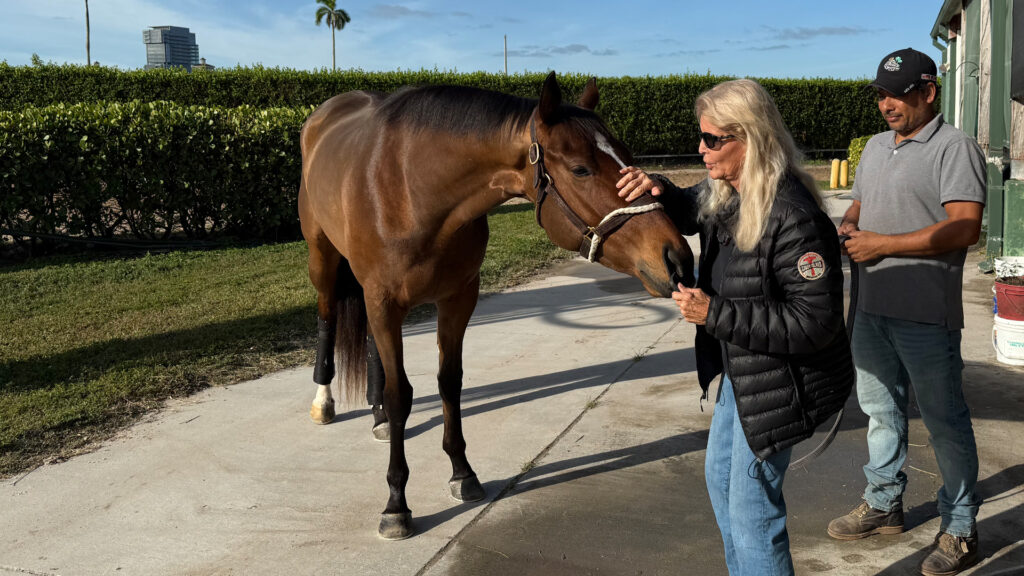
Over the past several decades, many racetracks and horsemen’s organizations have recognized the growing need for structured placement programs to assist Thoroughbreds after their racing careers conclude. While such initiatives were virtually nonexistent in the 1980s and 1990s, today they play an essential role in the welfare and reputation of the sport.
There Were Never Such Devoted Sisters
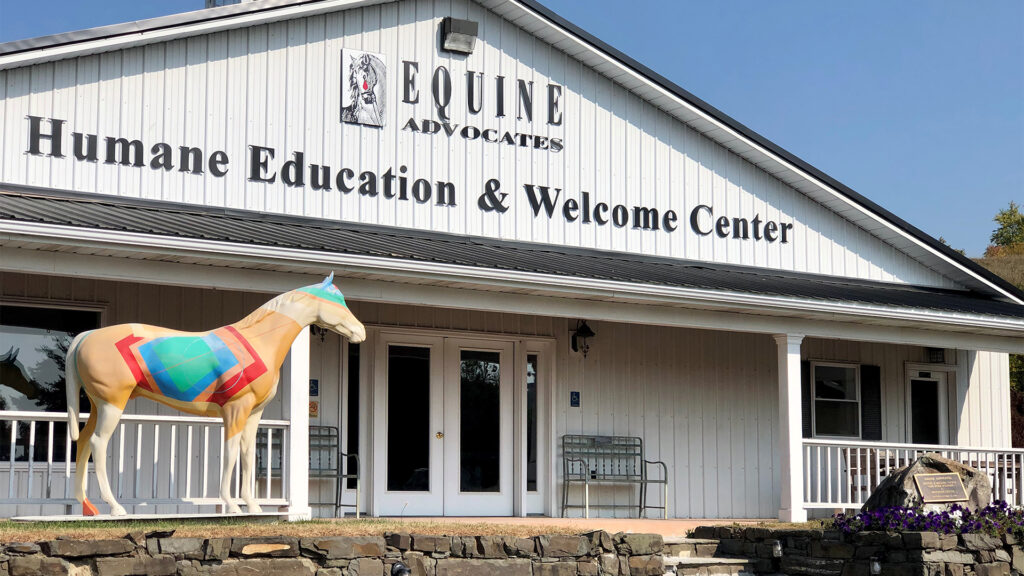
All Items Success Stories Aftercare Editorials Retraining Tips Supporter Features Equine-Assisted Learning Sanctuary Living Inspector Spotlights Hamburger Toggle Menu Previous PostNext Post There Were Never Such Devoted Sisters This article was originally featured in the July 2025 Issue of BloodHorse Magazine in the Second Acts series. This article is the original format and text. To read the BloodHorse article or to subscribe click HERE. There Were Never Such Devoted Sisters By: Suzie Picou-Oldham August 5, 2025 Aftercare Editorials Tags:accredited aftercare, Aftercare Organization, BloodHorse Magazine, Equine Advocates, Thoroughbred Aftercare, Thoroughbred Aftercare Alliance Equine Advocates Humane Education & Welcome Center (Provided by Equine Advocates) Susan and Karen Wagner Sisters, Susan, and Karen Wagner head the staff at Equine Advocates located in Chatham, New York. Accredited by Thoroughbred Aftercare Alliance since 2014, the organization is a national nonprofit 501(c)(3). Founded in 1996 when Susan Wagner rescued her first horse, Gandalf, from slaughter. He was a Thoroughbred/Quarter Horse cross that Susan calls a life-altering experience. Prior to founding Equine Advocates, Susan worked in the racing industry in various capacities, first as a hotwalker at Belmont. With a desire to learn more, she moved to Maryland and worked as a groom for Alfred Vanderbilt at Sagamore Farm. She wrote as well, including articles about racing while working out of the Belmont Park press box. From there, she took a job at a zoological institution during which time she found Gandalf in 1993. Equine Advocates Rescue and Sanctuary was established in 2004. Located in Chatham, in Upstate New York, the facility boasts a 173-acre haven of paddocks and shelters. Susan and Karen alongside a resolute staff have created more than just an equine haven, they have developed a village where equines live a life with daily care, love, and guardianship. The Wagner’s have made it the mission of Equine Advocates to promote the humane, responsible treatment of horses. Karen Wagner We have rescued and/or helped with more than 2,000 equines 32 years if you count the three years between the time I acquired Gandalf (and Rain Man who just turned 35) and founded Equine Advocates. I would estimate the number of Thoroughbreds we have assisted over the years has been in the hundreds. Susan Wagner When asked about their first Thoroughbred and reflecting on the number of Thoroughbreds they have taken in, Susan said, “We’re going back to 1996 which was when I founded this organization. One of the first or perhaps the first Thoroughbred we ever acquired was a 3-year-old Chestnut Thoroughbred Filly named, ‘Alarmingly Irish’ (Y20308) in 1998. I vividly remember the circumstances – She had been in training for her first race at Suffolk Downs and while in her stall, her leather halter got caught on a nail and she dislocated one of the bones in her skull (possibly the axis) when she was struggling to free herself. Somehow her trainer found me and asked if we could take her. I boarded her at Robin Hill Farm in Hunterdon County, NJ which was where we were keeping some of our horses at that time. A young woman fell in love with her, adopted her and renamed her, “Piper.” She kept Piper at that farm, and I got to see her often. I also remember how large and gorgeous Piper was. She was almost orange in color with no other markings and quite striking and beautiful. We have rescued and/or helped with more than 2,000 equines 32 years if you count the three years between the time I acquired Gandalf (and Rain Man who just turned 35) and founded Equine Advocates. I would estimate the number of Thoroughbreds we have assisted over the years has been in the hundreds.” Susan Wagner Students in Education Program (Provided by Equine Advocates) Students in Education Program (Provided by Equine Advocates) The Humane Education and Welcome Center opened in 2006 and is the schoolhouse of the operation. Classes and tours are offered to the public, especially to younger audiences to educate future generations about proper care and responsibilities of equines. Local schools, youth groups, Scout troops and other organizations have taken part in the Humane Education program. Now 30 years in operation, they are not only a haven for Thoroughbreds but also for donkeys, mules and other equine breeds including former Military Working Horses. Equine Advocates has been honored by the New York State Humane Association and the Thoroughbred Charities of America for excellence in equine protection and rescue work and are also accredited by the Global Federation of Animal Sanctuaries (GFAS) and the American Sanctuary Association. Symposiums have been held on equine cruelty for law enforcement where experts discussed how to recognize abuse/neglect cases and how to effectively enforce the cruelty laws. The importance of Responsible Horse Guardianship, behavioral traits, history, and origins of all breeds at the sanctuary, are among topics in classes at the Education Center. “We discuss what to do if a situation arises where one can no longer keep their horse to ensure that the animal goes to a good home or reputable sanctuary and never to a low-end auction and/or placed in a situation where that horse can fall through the cracks,” says Susan. The organization has published a book called Do Horses Sleep Standing Up? created and written by Karen Wagner. Staff includes a Social Media and Communications Manager, Humane Educator, Donor Relations Manager, Equine Care Managers and Maintenance Supervisor. A full board of directors are actively supportive. Melissa Murray, Equine Care Manager, has been at Equine Advocates for eight years. Explaining the roles between Karen and her sister, Susan explains, “I wear many hats here at Equine Advocates, as does my sister, Karen who runs the organization with me, but we mostly do very different things while working together on others. We both fundraise for the organization in different capacities, put on events, speak with and cultivate donors, and share in all the major decisions, projects, and development issues, etc. My job also involves expediting all the rescue operations
Remember Me Rescue: Donna Keen’s Lifelong Passion for Retired Racehorses
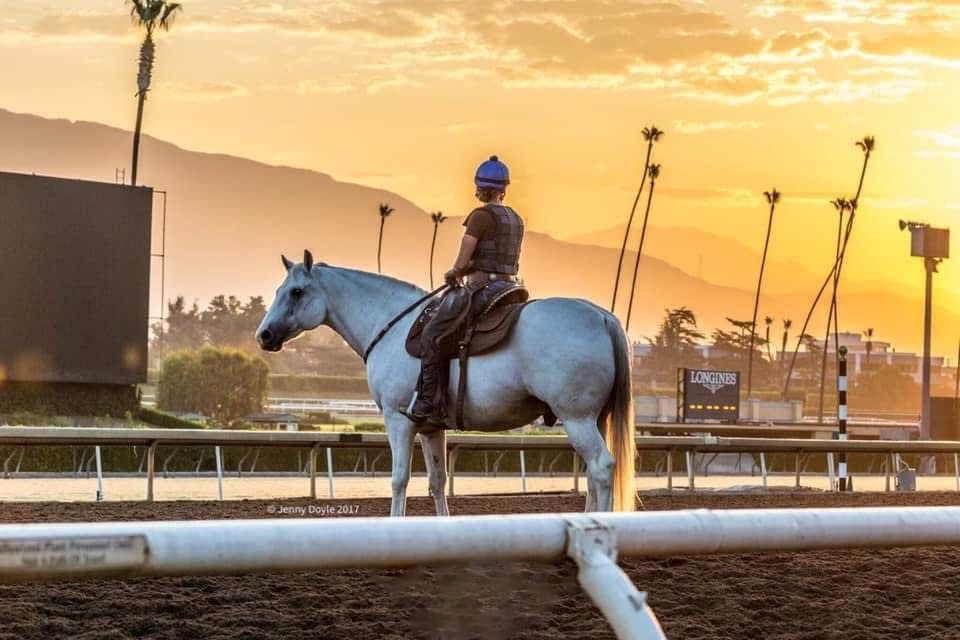
All Items Success Stories Aftercare Editorials Retraining Tips Supporter Features Equine-Assisted Learning Inspector Spotlights Hamburger Toggle Menu [wpdreams_ajaxsearchlite] Previous PostNext Post Remember Me Rescue: Donna Keen’s Lifelong Passion for Retired Racehorses This article was originally featured in the February 2025 Issue of BloodHorse Magazine in the Second Acts series. This article is the original format and text. To read the BloodHorse article or to subscribe click HERE. Remember Me Rescue: Donna Keen’s Lifelong Passion for Retired Racehorses By: Alexis Arbaugh February 21, 2025 Aftercare Editorials Tags:accredited aftercare, Aftercare Organization, BloodHorse Magazine, Donna Keen, Remember Me, Remember Me Rescue, Thoroughbred Aftercare, Thoroughbred Aftercare Alliance Photo Credit: Donna Keen Based in Burleson, Texas, Remember Me Rescue was founded in 2008 by Donna Keen, a passionate advocate for retired racehorses. Donna’s vision was to provide a safe place for owners and trainers to retire or rehome their racehorses. Remember Me Rescue was accredited by Thoroughbred Aftercare Alliance in 2014 and has since expanded its mission to meet the evolving needs of retired Thoroughbreds, caring for about 44 horses annually in rehabilitation, retraining for adoption, and sanctuary. Donna’s journey with horses began at 12 years old when her mother bought her an older horse. Before this, her family wasn’t involved with horses. Without a trainer or saddle, she learned “every lesson the hard way.” Later, her father bought her another horse and an English saddle. Reflecting on those early days, Donna recalls, “I’d jack my stirrups up to the top hole and gallop around the pasture, planning my jockey future.” Donna’s connection to racing was sparked when she met Johnny Hendricks, a trainer at a small training track in Mansfield, Texas. Despite lacking formal training, Donna seized every opportunity to ride, often choosing horses others wouldn’t. “I didn’t have the sense not to,” she remembers. “Johnny made me tough. He didn’t put up with any complaining or whining. I had to sit in my car and cry for about 30 minutes every day before I could drive home, but I sped back there every morning to keep doing what I loved—getting on horses.” Donna Keen on Bridless Wyatt. Photo Credit: Jenny Doyle In 1987, when Texas passed the parimutuel law requiring trainers to be licensed, Johnny encouraged Donna to take the test. After passing, she began her career as a trainer at Trinity Meadows Race Track in Weatherford, Texas. Early on, Donna worked evenings as a bartender to offset the costs of keeping horses at the track, often sleeping in her tack room. Mornings were spent riding all her own horses. Over time, Donna gained recognition as a trainer but also from her famous stable pony Wyatt, who was regularly ridden bridleless on the track. “Wyatt turned lots of heads and opened lots of doors for me,” Donna says. “He was a special horse and was well known from Santa Anita to Gulfstream Park.” Wyatt’s fame even led to Donna meeting her future husband, Dallas Keen, in 2004 at Lone Star Park. In 2007, Donna and Dallas married. The following year, they adopted Lights on Broadway, the 2001 Texas Horse of the Year, who had been abandoned and was at risk of being sent to an unfortunate fate. The adoption became pivotal for Donna. “I decided right then and there that more had to be done to save retired racehorses,” she reflected in a 2011 BloodHorse article, “Inspired by Lights: Beyond the Blinkers.” Photo Credit: Donna Keen After the adoption, the Texas Thoroughbred Association published an article about Lights on Broadway, which inspired the name of the rescue: Remember Me. Remember Me Rescue was officially founded as a 501(c)3 non-profit in 2008. Since its establishment, Remember Me Rescue has transformed its 20-acre property to include a 20-stall barn, a 2-stall quarantine barn, multiple paddocks, a round pen, and two riding arenas. Over the years, the organization has successfully placed hundreds of Thoroughbreds into forever homes. Donna credits the organization’s success to the Keens’ deep understanding of racetrack injuries and the habits that Thoroughbred racehorses develop. “I think what made us so successful at rehabilitating and retraining them was that we were very familiar with and knew all about the bad habits racehorses pick up—and how to turn them into positive reactions,” she explains. While most horses at Remember Me Rescue come from racetrack connections, as part of responsible retirement, some have come from dire situations, such as a 2012 Louisiana case in which Donna and Dallas took in 15 of the 60 horses seized from a Thoroughbred breeding farm after its owner was charged with animal cruelty. “I still have nightmares about that place,” Donna recalls. A positive outcome of this harrowing experience was meeting Rich Papiese of Midwest Thoroughbreds, who donated funding for their current 20-stall barn and 2-stall quarantine barn. “We would not be where we are without him and many other supporters over the years,” Donna shares. Remember Me Rescue carefully evaluates each horse to determine its suitability for a second career. The organization provides retraining to prepare them for new disciplines and collaborates with trainers, owners, and breeders to ensure horses receive the necessary second-career training, setting them up for success and readiness for adoption. The organization’s largest challenge is sustaining funding for its permanent residents. “It seems once a horse is in a safe place, the donations come to a screeching halt,” Donna explains. Remember Me Rescue supports several long-term residents, including a blind 18-year-old horse and his 28-year-old dam, as well as two other elderly horses (26 and 27). “I love the old guys and gals and would like to take in more if I could, but there’s no money to do that,” Donna laments. The rescue also has five long-term rehabilitation residents. Caring for permanent and long-term residents accounts for most of the rescue’s financial burden. Remember Me Rescue relies on various resources to fulfill its mission. In early 2024, it secured a grant from the North Texas Communities Foundation to build a large arena featuring
The Importance of Traceability in Thoroughbred Racing & Aftercare
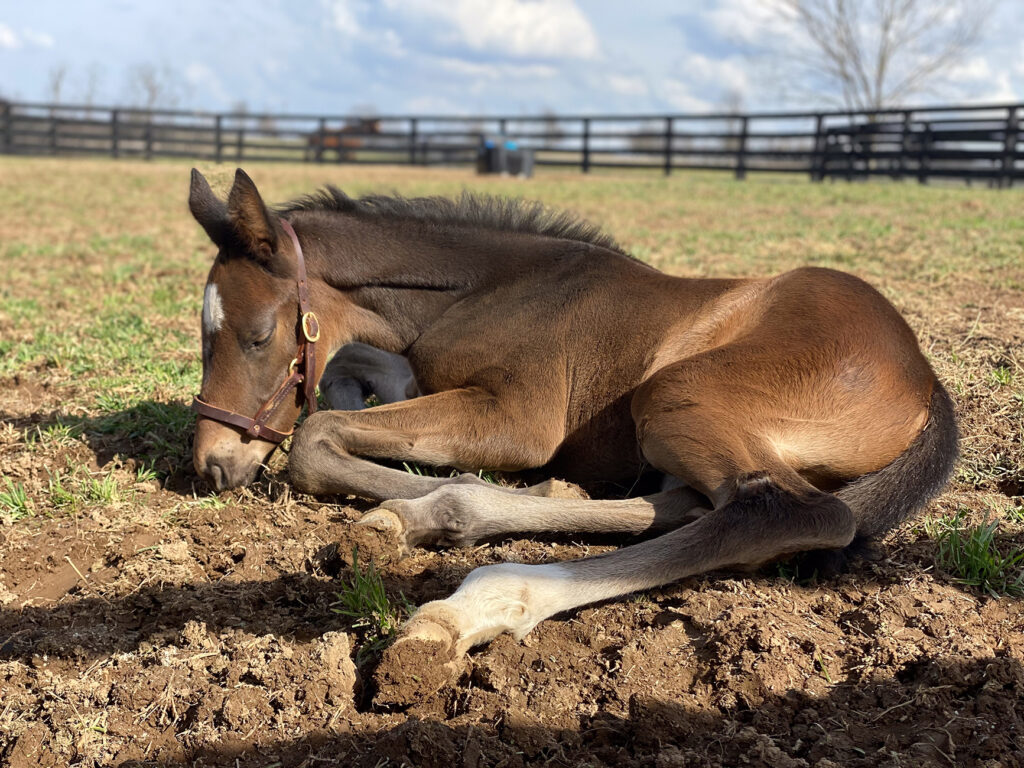
All Posts & News Press Releases Success Stories Aftercare Editorials Retraining Tips Supporter Features Inspector Spotlights Humberger Toggle Menu [wpdreams_ajaxsearchlite] Previous Post The Importance of Traceability in Thoroughbred Racing & Aftercare This article was originally featured in the July 2024 Issue of BloodHorse Magazine in the Second Acts series. This article is the original format and text. To read the BloodHorse article or to subscribe click HERE. The Importance of Traceability in Thoroughbred Racing & Aftercare By: Samantha Smith September 11, 2024 Aftercare Editorials Tags:BloodHorse Magazine, Equine Safety, Equine Welfare, Horse Inventory, The Jockey Club, Thoroughbred Aftercare, Thoroughbred Aftercare Alliance, Traceability Mom’s Reward pictured taking a nap. Tracking a horse’s information and whereabouts throughout its life, known as traceability, is indispensable in horse racing. It’s vital for equine welfare, industry integrity, and accountability. In North American Thoroughbred racing, traceability is essential from birth to post-racing but poses persistent challenges. Effective inventory control should be a priority, reducing uncertainty about Thoroughbreds’ whereabouts. Thoroughbred Aftercare Alliance mandates inventory reports from accredited organizations, although only after horses reach these facilities. Thoroughbred Aftercare Alliance consulted with various racing professionals, gaining insights into traceability challenges and perspectives across the industry. Jill’s Story: A Breeders’ Quest for Traceability and Accountability Jill Pritchard, a dedicated equestrian and breeder, emphasizes the importance of traceability in racing. Her firsthand experiences underscore the challenges breeders face in ensuring the welfare and whereabouts of their horses. Jill shares both positive and negative anecdotes, illustrating where challenges beyond her control persist and improvements can be made. Despite her best efforts, she couldn’t trace some foals after selling them as yearlings, reflecting broader industry challenges in ensuring Thoroughbred welfare and whereabouts. Mom’s Reward pictured as a foal. Photo Credit: Amy Lanigan. Mom’s Reward Mom’s Reward is a tragic example of a horse lost in the system. A 2021 filly by Preservationist out of Ventoux. After her sale, the filly never had a published workout, let alone raced. Despite Jill’s attempts to contact the trainer, she received no response. Eventually, Jill learned that Mom’s Reward was euthanized due to a breakdown in training, though this information remains unconfirmed. The lack of traceability and communication left Jill feeling helpless. Unable to confirm the horse’s fate or reach the trainer, she could do nothing to assist Mom’s Reward. Kicksandgiggles pictured at the sales. Kicksandgiggles Kicksandgiggles, trained by Jeff Hiles, stands out as a success story amid the challenges of traceability. Kicksandgiggles is a 2020 gelding by Bernardini out of Driving Rain. Thanks to the help of Buff Bradley, Jill was able to connect with the trainer when she sold him as a yearling and maintain communication with Jeff Hiles throughout the horse’s career. Jill was able to get the horse back when Jeff was ready to retire him, and ensured he transitioned into training for a second career. Today, Kicksandgiggles lives happily with his new owner in Minnesota, a testament to the importance of open communication and accountability in ensuring the welfare of Thoroughbreds beyond the racetrack. Bottle Rocket Bottle Rocket, a 2012 colt by Intense Focus out of Shoes to Match, was sold as a weanling for $5,500 and went on to win over $226,000. His first owner and trainer kept Jill updated on his progress, but after he was claimed and moved out West, communication became difficult. Eventually, Jill learned from a trainer that Bottle Rocket was retired to the owner’s farm after his last race at Del Mar. Over two years later, he resurfaced at a Quarter Horse meet in Los Alamitos. Despite her best efforts, including speaking with the track steward and reaching out on social media through the Posse Foundation and various Thoroughbred groups, Jill was unable to get any updates from his connections or determine his whereabouts after his last race in January 2020. Kicksandgiggles as a foal with his mother. Kicksandgiggles playing in the field. Kicksandgiggles as a foal. Jill with Mom’s Reward. Mom’s Reward taking a nap. The Registration Process The Jockey Club is the breed registry for North American Thoroughbreds, and it outlines the eligibility rules and requirements for a foal to become a registered Thoroughbred. Since 2017, the implant and reporting of a microchip has been a condition of registration, and in 2018 Digital Certificates of Foal Registration were introduced, replacing traditional paper documents. Both initiatives were aimed at improving identification tools for Thoroughbreds, but also to enhance means of traceability. While these measures have been a welcome development for the Thoroughbred industry, the responsibility of updating ownership still lies primarily upon individual stakeholders. Best practices would see ownership being updated to The Jockey Club each time a horse is transferred, but compliance isn’t guaranteed. Beyond Racing Once a Thoroughbred’s racing career ends, tracking its post-racing journey can be additionally challenging. While the breed registry does not mandate reporting a horse’s retirement, a process is available through The Jockey Club, called Transferred as Retired from Racing, that enables an owner to retire a Thoroughbred from racing without affecting its breeding privileges. If a Transferred as Retired from Racing Thoroughbred is entered at a North American racetrack, racing officials are electronically notified that the horse is retired. In addition, it is free to transfer ownership of a Thoroughbred using The Jockey Club Registry’s Interactive Registration at registry.jockeyclub.com. In addition, once a horse makes it to a Thoroughbred Aftercare Alliance-accredited facility, there are mandatory requirements in place for reporting and managing horse inventory. “Thoroughbred Aftercare Alliance mandates inventory reports from all accredited organizations four times annually,” said Suzie Oldham, Thoroughbred Aftercare Alliance, Inspections Administrator. “This meticulous approach ensures that horses at each of the organization’s facilities are registered Thoroughbreds creating a traceable record of horses passing through the program and offering peace of mind to previous owners who may be seeking their equine companions.” Conclusion From birth to retirement, every horse deserves a clear and accountable journey. With industry-wide initiatives and advancements in technology, the goal of comprehensive traceability is within reach. As The Jockey Club’s traceability
Remembering Viva Pentelicus: From the Racetrack to Compassion and Connection – A Tale of Resilience
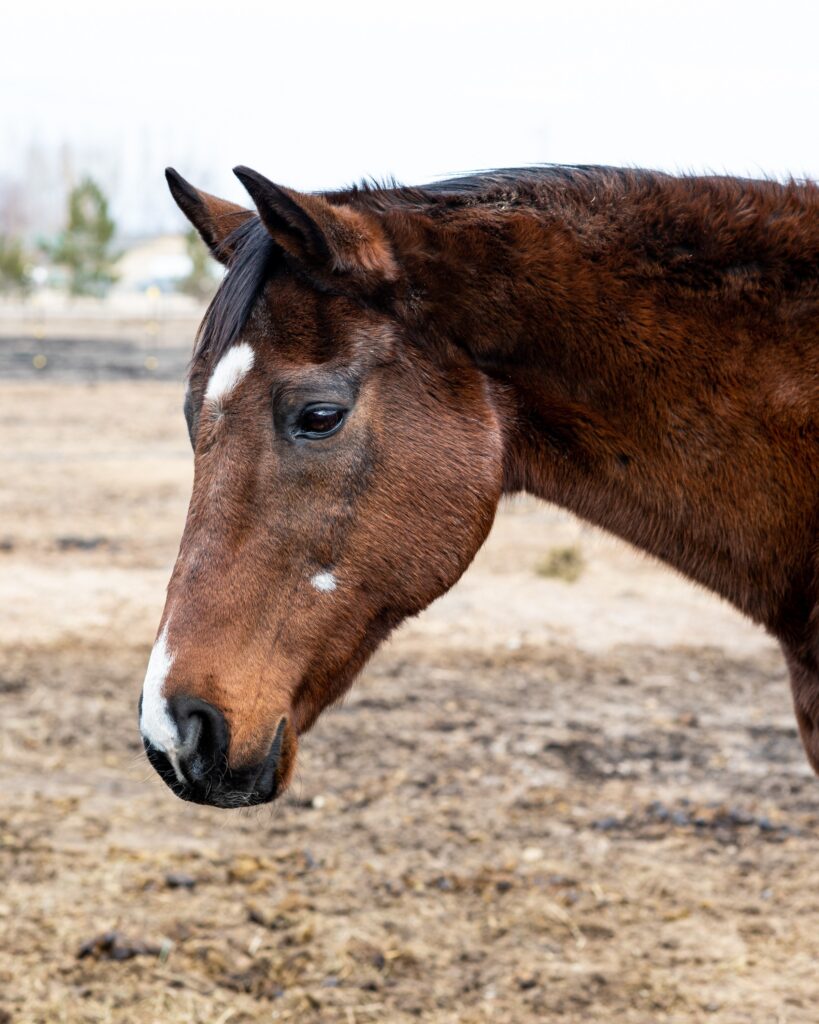
All Posts Press Releases Success Stories Aftercare Editorials [wpdreams_ajaxsearchlite] Previous Post Remembering Viva Pentelicus This article was originally featured in the February 2024 Issue of BloodHorse Magazine in the Second Acts series. This article is the original format and text. To read the BloodHorse article or to subscribe click HERE. Remembering Viva Pentelicus: From Racetrack to Compassion and Connection – A Tale of Resilience By: Alexis Arbaugh February 13, 2024 Aftercare Editorials, Success Stories Tags:Healing Arenas, Success story, Thoroughbred Aftercare, Thoroughbred Aftercare Alliance, Thoroughbred Retirement Foundation Thoroughbred racehorses, beyond the racetrack, have the opportunity to start the second chapter of their life. Thoroughbreds who are bred for speed and purpose deserve fulfilling post-racing careers that honor their lineage and natural drive, guiding them toward a new future while respecting their racing legacy. Thoroughbred Aftercare Alliance-accredited organizations provide care and opportunities to our Thoroughbreds, unlocking their potential and showcasing their versatility beyond the track and ensuring a fulfilling, meaningful life beyond their racing days. Numerous off-the-track Thoroughbreds are allowed the remarkable opportunity to evolve beyond their racing origins, finding new roles as riding horses, therapy horses, etc. each one fulfilling a unique purpose in their new life. Viva Pentelicus, a 1996 gelding by Pentelicus out of Vivacious Sheila, arrived at Healing Arenas in late 2012 from Flying Y, a Thoroughbred Retirement Foundation (TRF) farm in Oklahoma. Healing Arenas had partnered with TRF to launch a Second Chances program for California – a program that eventually became Healing Arenas’ own equine-assisted therapy program. After selecting Viva and a few others, Healing Arenas loaded up their trailer and headed home to their farm in California. Viva had retired to Thoroughbred Retirement Foundation in 2005 after starting in 96 races at more than 20 tracks across the country over the course of 8 years, earning $347,494 from a record of 22 wins, 9 seconds, and 14 thirds. At just 15.1 hands, he was nicknamed “the little horse that could” for his immense heart and try. Steve Trizis, a partial owner of Viva during his racing career, recalls a time when they sent him to a farm for a break and relaxation between races for a few months. The farm manager called Steve back a month into Viva’s stay, pleading them to take him back to the track. Viva was restless with a strong desire to run, and the supposedly relaxing vacation turned out to be anything but. Steve and his crew picked Viva up and brought him home to the track, where Viva appeared more relaxed doing his job on the track than anywhere else. Viva’s heart carried him through his entire racing career, and he finished first, second, and second in his final three starts in the fall of 2005. He then did get a well-deserved retirement vacation at TRF’s Flying Y until he was picked out by Julie Baker of Healing Arenas. While all the horses brought home for the burgeoning Healing Arenas’ equine-assisted therapy program were special, 16-year-old Viva had a personality nobody could ignore. He was ready for a new job, and it was as if he knew when he stepped off the trailer, his purpose was connecting with people and helping them heal. “When I first saw him,” Julie remembers, “it took about 15 seconds for me to realize how much class he has and how much I wanted him. He was a classy, old-school horse. He’s a warhorse, and right after I met him, I made up my mind that he would never leave me.” In his 11 years at Healing Arenas and through a move with the program from California to Nevada, Viva assisted numerous groups through therapy: veterans, PTSD victims, first responders, foster youth, trafficking victims, and individuals and couples in counseling. Throughout these sessions, participants didn’t just receive therapy; they also acquired crucial horsemanship skills. Viva seemed to recognize when he was being called, as the distinctive call involved singing “Viva Las Vegas,” and it was as if he understood that they were singing to him. Among the many individuals impacted by Viva, one special story stands out above the rest. Viva played a significant role in helping a 17-year-old in foster care who was on the verge of aging out of the system. The teen, initially introverted and struggling to connect with people, found solace and guidance with Viva. Through their interactions, Viva helped him realize that it’s okay to reach out and connect with others. By the end of his time in the foster care system, the young individual had gained the confidence to lead his group, delegate responsibilities, and take control of his life. Viva also played a role in teaching veterinary technician students as he participated in their “live labs.” He thoroughly enjoyed the attention he received from both vet tech and therapy students, just as much as these students cherished being around him. Viva served as the poster child for Healing Arenas, and on National Agriculture Day in 2016, the then 20-year-old represented his breed at the California State Capitol in Sacramento, interacting with elected officials, staff, and the public. He served as a great example of the versatility of Thoroughbreds, proving wrong many of the misconceptions about racehorses and their ability to succeed in second careers after racing. Viva offered care and support consistently until he passed away at the age of 27 in August of 2023. A painted portrait of Viva now hangs at Healing Arenas, a gift from one of their volunteers and Viva’s biggest fan. It serves as a reminder of his enduring spirit—a symbol of hope and kindness that continues to inspire and guide those on the path to healing. Viva, the spirited Thoroughbred, went from a winner on the racetrack to the heart of equine-assisted therapy. His journey tells a story of resilience and the power of connection. Through therapy sessions and teaching moments, Viva not only offered comfort but also shared important life lessons. Thoroughbred Aftercare Alliance has awarded accreditation to both
It Takes A Village: Tomater Gator’s Soft Landing to OTTB
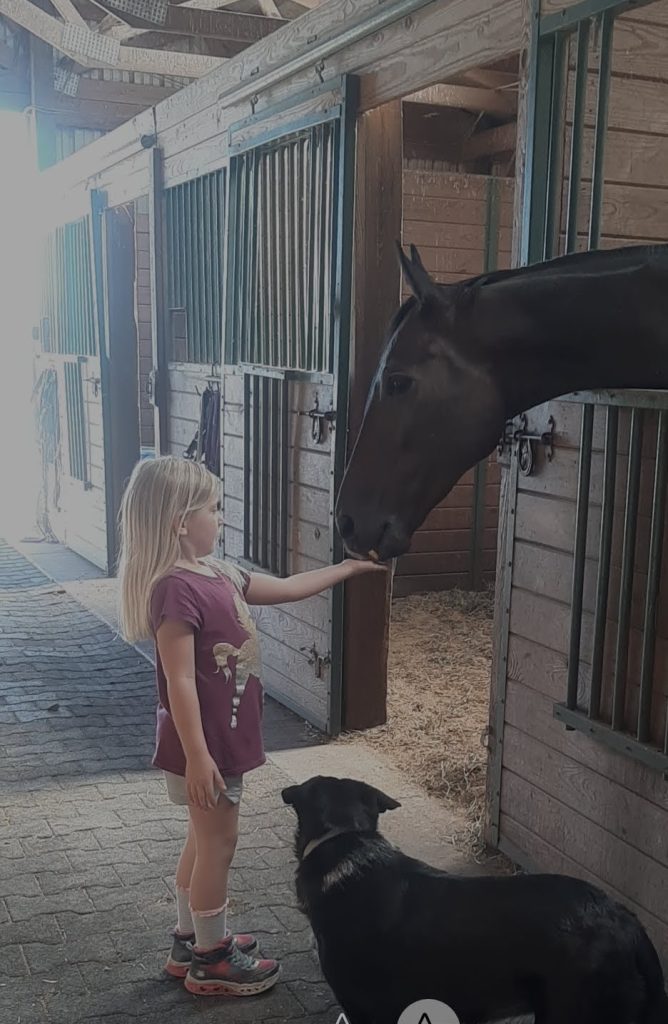
All Posts Press Releases Success Stories Aftercare Editorials [wpdreams_ajaxsearchlite] Previous PostNext Post It Takes a Village This article was originally featured in the February 2024 Issue of BloodHorse Magazine in the Second Acts series. This article is the original format and text. To read the BloodHorse article or to subscribe click HERE. It Takes a Village Tomater Gator’s Soft Landing to OTTB December 15, 2023 By: Stacie Clark Rogers The heartwarming story of Tomater Gator’s retirement is a touching story that the industry cannot afford to overlook. Tomater Gator concluded his racing career in August 2023 with a respectable fourth-place finish. It was at this moment that his owner and trainer, Leandro Barban, made the decision to sell him for a well-deserved retirement. The 8-year-old veteran gelding had raced an amazing 85 times in just seven years. During his remarkable career, he achieved 12 victories and amassed earnings exceeding $282,000. In the world of Thoroughbred racing, a horse with Tomater Gator’s extensive racing history is often referred to as a ‘war horse.’ Surprisingly, these ‘war horses’ often remain relatively unknown to the broader horse racing community. No stranger to the world of racing and racetracks, Tomater Gator ran the majority of his starts at Penn National Racetrack or PARX Racing. However, this seasoned racehorse ventured beyond his usual tracks, making the journey from Pennsylvania to South Florida to compete at no fewer than six different racetracks. Remarkably, he was claimed 19 times over the course of his incredible career. As Tomater Gator prepared for another race at Penn, little did he know that a movement was underway to secure his well-deserved retirement. Just under a week after running in a claiming race with a purse of $7,000, Tomater Gator found himself turned out and basking in the joys of retirement. It’s not uncommon for these veteran ‘war horses’ to garner a dedicated following on social media, particularly among supporters for Off-the-Track Thoroughbreds (OTTBs). In the case of Tomater Gator, one such fan was Fran Burns, the founder of Maryland’s Thoroughbred Show Series, who had been avidly following Tomater Gator’s journey on social media for a couple of years. “I watched him closely on Twitter within a group dedicated to following older racehorses. Tomater Gator was primarily competing at PARX, and I found myself tracking his journey for not just a couple, but perhaps closer to three years,” Fran exclaimed with excitement. “I kept sending donations to MidAtlantic Thoroughbred Rescue, directed specifically for Tomater Gator. I truly believed we could secure his retirement.” Fran chuckled, recalling her interactions with Bev Strauss, the Executive Director of MidAtlantic Thoroughbred Rescue, a Thoroughbred Aftercare Alliance accredited organization. “Bev would often laugh at me; I think she thought I was a bit crazy.” Horses like Tomater Gator, who find themselves on public watch lists, deserve recognition. Tomater Gator could have easily slipped through the cracks of the system. However, thanks to another passionate OTTB advocate, an anonymous supporter determined to contribute to his retirement, Tomater Gator’s story took a different turn. “Gater had been listed as a horse to watch for the past two years,” his secret admirer noted. “So, I decided to reach out to Rick Schosberg, a Thoroughbred Aftercare Alliance board member from NYTHA, to assist me in locating Gator’s connections.” Even with Rick’s assistance, reaching the trainer proved challenging. But eventually, the message was conveyed: “We would like to help Gator retire.” Fast forward to the week of August 30th, when Tomater Gator was gearing up for his final race at Penn. During this critical time, Thoroughbred Aftercare Alliance received an unexpected text message from an anonymous admirer of Tomater Gator. “Hey, no pressure, but I’ve been following a particular horse for a while now, and the owner/trainer has expressed willingness to sell. Do you happen to have any contacts I could discuss rehoming with?” the message read. The Thoroughbred Aftercare Alliance office had no prior knowledge of Tomater Gator’s dedicated following or the ongoing donations to MidAtlantic Thoroughbred Rescue (MAHR) in his name. Yet by an incredible stroke of coincidence, Thoroughbred Aftercare Alliance suggested that the anonymous friend contact Bev Strauss. When Bev received the call, she couldn’t help but burst into laughter. “This horse has been on Fran’s radar for three years!” she exclaimed. Without delay, Bev reached out to Fran to share the exciting news. Tomater Gator had found a generous benefactor, and Bev was making immediate arrangements for his pickup. She also reached out to Beth Walker and Joe Topper, trusted associates from MAHR’s rehab facility at Breezy Hill Stables, who readily agreed to collect Tomater Gator the following day. The inner circle of Tomater Gator’s newfound friends was overjoyed by their successful effort in securing him a well-deserved retirement. It became evident that Tomater Gator’s circle of support was more extensive than anyone had initially realized. After successfully picking up Tomater Gator, Bev Strauss took to social media to share the news: “Exciting news! Tomater Gator has officially retired, and it truly took a village. The outpouring of support and enthusiasm from all of you has been incredible. As his racing days came to an end, it’s heartening to see this veteran horse find a safe and happy place.” Bev’s post sparked a wave of positive reactions, with dozens of comments, several shares, and nearly 500 acknowledgments, underscoring the widespread appreciation for the efforts made on Tomater Gator’s behalf. One Facebook connection highlighted, “He finished in the top three in 41.18%. Gotta love these war horses!” Other comments included expressions like, “It takes a village,” and another person noted, “Many fans have been following Tomater Gator, and we were all so excited last night to hear the news of his retirement. Even better news that it was MidAtlantic that swiftly stepped in to make this happen. Thank you, Fran Burns and MAHR.” Numerous individuals sent texts of support, such as, “Props to all of his connections; he looks great.” The placement of Tomater Gator in his
Why an OTTB is an Excellent Therapy Horse
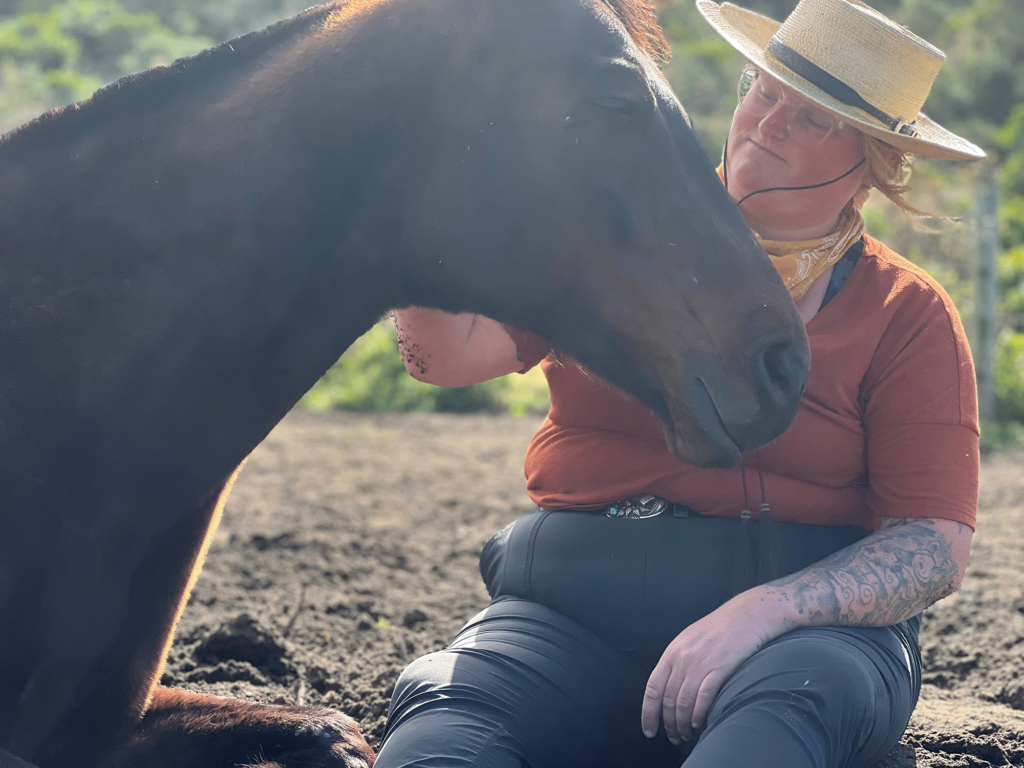
This article was originally featured in the October 2023 Issue of BloodHorse Magazine in the Second Acts series. This article is the original format and text. To read the BloodHorse article or to subscribe click HERE. Why an OTTB is an Excellent Therapy Horse October 16, 2024 By: Joell Dunlap Square Peg horse Kentucky Guy with Instructor Emma Bond There’s a lovely breeding farm in our quaint coastal California town of Half Moon Bay. The founder, a dear friend and colleague of mine, has every reason to take pride in her farm and the reputation earned for breeding successful show jumpers competing against European bloodlines. Recently, she called to offer me a gelding for our program. He’s young with a lovely temperament. However, it’s clear he won’t meet requirements for the International Jumper circuit. Rather than opting for a quick sale that might lead to unfavorable circumstances, the owners are determined to secure him a wonderful home. I returned the call and thanked her for thinking of us. I took the opportunity to remind her the racing industry frequently provides us with numerous lovely geldings with pleasant temperaments. Unlike the showjumping industry, the racing industry remains supportive of our program and provides critical operating funds. “But this gelding has three months training with a very good trainer,” my friend informed me. She is correct; the trainer is very good. She continued, “and he’s much further along than anything you would get fresh off the track.” I’ve been sitting on that comment all day. Last year, I traveled to Ireland and visited the Irish National Stud. We met some folks on our tour including a woman who had worked for years in a therapeutic riding program. “But you would never use one of these horses in your program?” She gestured towards the lovely, retired racehorses grazing peacefully in paddocks. “Yes,” I replied, “that’s exactly who we use.” “Well, not Thoroughbreds with hot bloodlines like this?” she stammered. My mind drifted to the array of bloodlines back home who were kindly caring for our families at Square Peg: Bodemeister, Kingmambo, Unusual Heat, Afleet Alex, and Fusaichi Pegasus. You probably can’t get hotter than those. I’m a sucker for a nice pedigree. Both conversations involved experienced and professional horse enthusiasts, and both conveyed the notion that off the track Thoroughbreds are, at best, poorly suited for the type of work we engage in. work we engage in. Joell Dunlap shares a quiet moment with Fravel, a son of Unusual Heat who came to Square Peg after a winless racing career Let’s spend a quick minute on “what we do.” Because it’s important: Square Peg currently maintains a herd of 24 horses. Seventeen of them are registered Thoroughbreds. We serve the Square Pegs of the world – that is to say, people who have been marginalized. Our specialty is in serving the autism community and we’ve been doing it since 2004. Our horses are riding horses and our approach is to help people regulate using a calm horse with a strong and steady rhythm. We are obsessive geeks who study the Classical Masters of Horsemanship: Baucher, Olivera, Pluvinel. We’re honored to be mentored by the Valenca Family of Portugal and we’ve studied under Christian Bachinger, Second Rider for the Spanish Riding School of Vienna. I say this not for bragging rights (okay, I’m admittedly proud of it, but it’s not the point) but to illustrate that this isn’t a program of glorified pony rides or of herd observation unmounted work. Not that either of those doesn’t have therapeutic effects, but it’s not what we do. These Thoroughbreds, which are often marginalized as being “too reactive, too fragile, too big,” possess the capacity for Classical Dressage including piaffe, passage, terre y terre and more. Our mentors are continually amazed at the willingness our Thoroughbreds show to learn, to try, to meet soft aids with honesty and integrity. It would be remiss not to acknowledge the therapeutic impact of a Thoroughbred’s sheer beauty when discussing the breed. The athleticism, the sought-after “look of eagles” we seek in the sales ring, the symmetry, the intelligent ears, and the inquisitive eyes all contribute to the profound sense of awe evoked by the Thoroughbred’s majestic presence. When a Thoroughbred showcases their unique quirks or displays their individual personality, it brings about a sense of lightness, awe, and gratitude. These emotions play a crucial role in a healing regimen, and once again, the Thoroughbred delivers on all points. Microrithms, was trained by hall of Famer Bob Baffern, was accomplished on the racetrack and is now ably serving the autism community at Square Peg. While it may be evident to most of us, my initial observations show the necessity to emphasize – a Thoroughbred “right off the track” has plenty of experience you don’t see in another breed of the same age. Racehorses have been exposed to regular riding, handling, bathing, transportation, shoeing, and grooming. They’ve encountered tractors, cars, bicycles, crowds, loudspeakers, flapping laundry, barn goats, and much more. Familiar with being ponied by another horse, they are unfazed by the sight of other horses being led in the same manner. There’s more to these amazing athletes: unlike any other breed I’ve encountered, they are attuned to humans. They have been in close concert with, at work and home with humans as part of their herd, part of their livelihood – an interwoven part of their social fabric – for their entire lives. They look to humans for care, comfort, play, and companionship. This is what heals us. This is what makes horse stories our favorite stories. This is what teaches us about ourselves, about our capacity for seeing others and being seen ourselves. This is how we learn about forgiveness. To watch a Thoroughbred in a post parade – heading over to give his very best – we see athleticism, we see lithe muscles coiled and ready to carry our hopes, or at least our live Daily Double wager dreams
Revisiting the Conversation on How to Solve Thoroughbred Aftercare
THE CHALLENGES ARE OUTRUNNING THE REMEDIES By STACIE CLARK ROGERS Thoroughbred racing is currently undergoing a period of introspection. While we have surpassed previous efforts to revolutionize the sport, areas remain where the fundamental infrastructure must be examined. For a while, we have been grappling with the legacy of our sport and unwavering commitment to horse welfare. It is disheartening to admit the challenges we face are outpacing the proposed solutions and implementations. INCEPTION & ORIGINAL PROPOSAL As a prominent international sport, one of the most admirable and exhilarating initiatives we embarked upon in North America was the establishment of the Thoroughbred Aftercare Alliance for the explicit purpose of addressing concerns regarding welfare of Thoroughbreds post-racing. Its primary mission is to establish a comprehensive system that oversees and ensures the well-being of retired Thoroughbreds, while offering financial support to those entrusted with their care. Over the past 11 years, some considerable strides have been made in terms of raising awareness and garnering support for aftercare within the industry. Nevertheless, there remains a pervasive sense of misunderstanding surrounding its objectives and functions. The original model involved collecting contributions at various stages of a Thoroughbred’s life, including registration and licensing fees and contributions from racetracks, breeders, sales companies, and ADWs (Advance Deposit Wagering). Other countries such as Japan, France, and Australia have successfully adopted similar approaches. However, in North America, the practical implementation has fallen disappointingly short of the idealistic vision. CHALLENGES – NO ONE WANTS TO TALK ABOUT IT As expressed by John Phillips, former president of the Thoroughbred Aftercare Alliance, the pathways for contribution have quickly become detours. Unfortunately, a similar resistance is witnessed within the industry when it comes to medication reform, as engaging in such discussions is often viewed as uncomfortable or unglamorous. It fails to hold the same allure or retain the same attention from industry stakeholders and fans as selling a yearling for a million dollars or triumphing in a prestigious stakes race. Having served as a former member of the Thoroughbred Aftercare Alliance board and now working as the operations consultant, I have firsthand experience of the challenges in aftercare. These include the daunting struggle for funding and the distressing presence of kill pens, which understandably make everyone uncomfortable. During my early involvement, a fellow board member asked for an honest assessment. I candidly addressed issues like the loss of stallion farms, individuals opting out of sales, and a perceived sense of competitiveness within aftercare. They then asked if there was any good news, and I felt as though I had profoundly disappointed them. This experience made me realize that aftercare issues are not eagerly discussed. When the Thoroughbred Aftercare Alliance was initially established, we genuinely believed it held the answers to the problems we faced. However, refusing to reassess our approach to aftercare is only impeding the progress of the Thoroughbred Aftercare Alliance. CHALLENGES – PUBLIC SCRUTINITY & SUSTAINABILITY OF THE SPORT Thoroughbred racing and breeding face intense public scrutiny. The industry lacks accountability for the well-being of the horses we breed, sell, compete with, and race against. This is a situation that demands immediate change. The recent instances of horses breaking down in and around Triple Crown races, despite concerted efforts to minimize injuries at premier tracks, should serve as a wake-up call for all of us. As seasoned individuals within this industry, we are acutely aware that injuries and the subsequent need for aftercare could be an existential threat to our industry that demands our urgent attention. This is no longer just an agricultural concern. Our industry’s social license to operate could be at risk, as the public rightfully has a voice in the lifespan and well-being of Thoroughbreds, akin to their involvement in the care of animals residing in zoos and aquariums. We must prioritize the well-being of every horse involved, not just our own. It is our collective duty. It’s time to address aftercare proactively and directly. We can no longer afford to bury our heads in the sand. CHALLENGES – INADEQUATE FUNDING & SUPPORT The Thoroughbred Aftercare Alliance provides approximately $3.5 million annually to 81 accredited organizations. For these organizations, Thoroughbred care expenses alone stand at approximately $17 million (based on 2021 figures, with costs expected to continue rising). The total budgets for the accredited organizations amount to roughly $46 million per year. Not only does the granted amount fall short of horse care alone, it also fails to cover essential business costs. Additional funding is crucial for racehorse retirement and well-being, as current resources are inadequate. Funding has decreased as the number of organizations and horses has grown. It is paramount that we ensure organizations possess the necessary resources to provide optimal care for retired racehorses, and we must actively encourage the industry to lend financial support. By doing so, we can positively impact Thoroughbred lives and improve industry perception. Organizations assisting horses from lower-tier tracks and distressing situations operate with limited funding from the sources from which these Thoroughbreds originated. Consequently, these organizations are compelled to devote additional time and resources rehabilitating these horses, thereby incurring additional costs. To ensure the well-being of these vulnerable horses, we must address this funding disparity and provide increased support for their rehabilitation and rehoming efforts. By bolstering their resources, we can enhance the effectiveness of their efforts and safeguard the welfare of retired racehorses across the spectrum of tracks and circumstances. CHALLENGES – DISPARITY IN ACCESS We find ourselves in a rather unique scenario characterized by what can be termed as “elite aftercare.” In certain fortunate instances, when a Thoroughbred can race at a track with an aftercare fund, a stipend is often provided to support its transition to an aftercare organization. Sometimes owners are even approached to make additional donations. These horses undergoing such triage are in an ideal situation where resources are readily available, and within these organizations with substantial funding from various sources, the adoption rates are notably high. This elite form of aftercare is indeed
A Path Forward through Collaboration
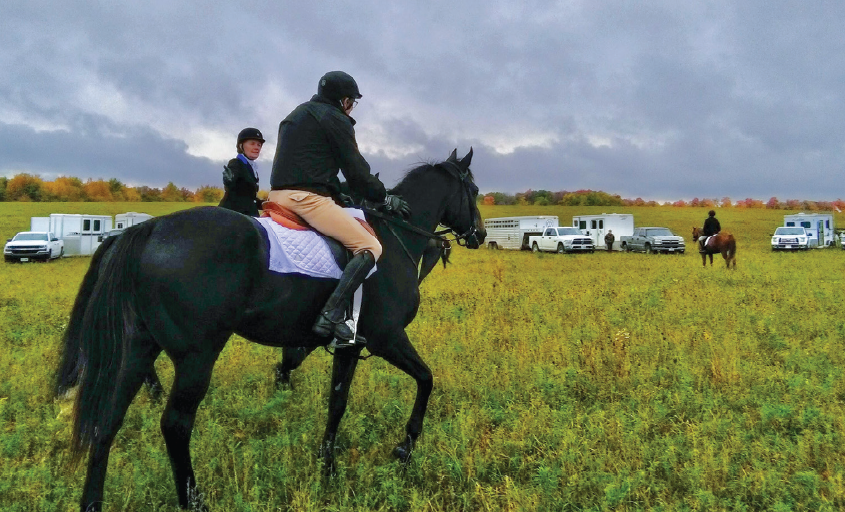
When professional Hunter/Jumper trainer Joyce Brinsfield of Ballyhigh Show Stable, Ltd. received a call from her long-time friend Paula Singer one day in March 2021, she knew she would soon be a part of a new journey.
After 25 years of friendship, it didn’t take much to convince Brinsfield to accompany Singer to Thoroughbred Aftercare Alliance-Accredited Kentucky Equine Adoption Center in Nicholasville, KY to meet SAVE ME PAULA- a 2017 Super Saver gelding in need of a new home.
First-Hand Review
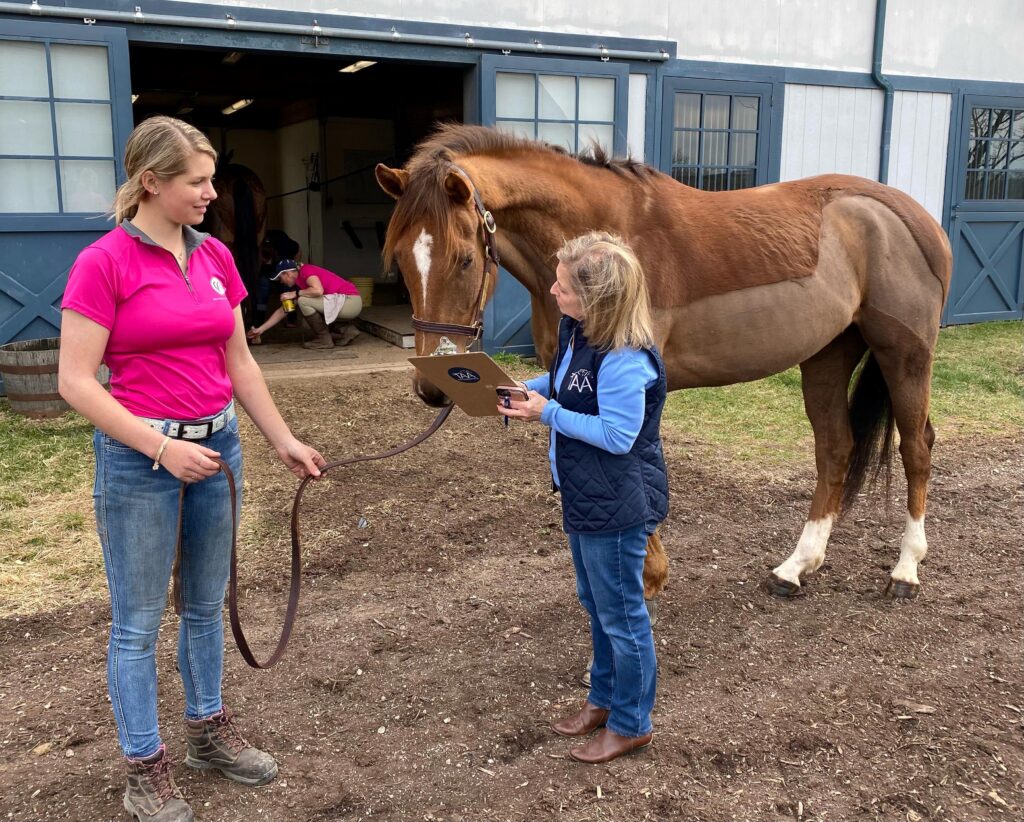
TAA Inspections, ‘Not Just a Look Around the Barn’ By Suzie Picou-Oldham I spent most of my early life on the racetrack backstretch as the daughter and assistant of a trainer and then as a jockey. My vision was limited to the business of racing. While we had horses that didn’t want to race or were not competitive enough, we found secondary homes and careers for them, or the owners would take them home. Later as the wife of a jockey, the horses would come and go in a flash. We seldom knew much about their history. As I became involved in the Thoroughbred breeding world, I saw horses come from the track as stallions and broodmares at different class levels. Now, in my seventh year as the inspections administrator with the Thoroughbred Aftercare Alliance, I have learned so much about the efforts to repurpose racehorses. Aftercare is as much a part of our industry as racing and breeding. ACCREDITATION The TAA accredits, inspects, and awards grants to approved aftercare organizations that retire, retrain, and rehome Thoroughbreds. The process begins with an in-depth application. Only after the submission of all required documents and information will the accreditation committee review the application. If approved, the organization will be recommended for inspection as the next step of the accreditation process. Organizations can have one or several facilities where their program horses are housed or boarded. Each facility must be inspected by a TAA representative. The total number of facilities in need of inspection will vary from 165-180 for the current 81 organizations. TYPES OF INSPECTIONS Organizations apply for TAA accreditation every two years. For accreditation, an inspection includes a detailed questionnaire, a look at all aspects of each facility, and an evaluation of each horse. Every facility boarding registered Thoroughbreds for an organization will be inspected in this process. In their “off” year a re-inspection takes place. This form consists of a checklist relating to basic equine care and the TAA Code of Standards plus an evaluation of each horse. At least one of each organization’s facilities will be inspected in the year they do not apply for accreditation. Once accredited, organizations are required to submit a Self-Inspection form for each facility with photos twice during the year. CHOOSING INSPECTORS As the inspections administrator, I will inspect as many facilities as possible. Inspections provide opportunity to meet the people doing the heavy work to rehome or retrain Thoroughbreds. We see how the people interact with the horses and the demeanor of the animals toward them. Many of the people at aftercare facilities work on a voluntary basis and have real jobs aside from the operation. The dedication is tremendous and something everyone should be aware of. For most inspections, I search for worthy candidates to do the job. TAA inspectors are chosen from a list of veterinarians and various equine professionals who have cared for Thoroughbreds at a level commensurate to the experience needed for inspections. They must evaluate each Thoroughbred or program horse, the facility grounds, and operations. The American Association of Equine Practitioners has been a reliable source for prospective inspectors. Other professionals come to us by recommendation or have submitted a volunteer form that is reviewed regarding experience and background. Coordinating inspectors and inspections is quite an exercise in mapping and communication. Finding the closest possible inspector helps manage travel expenses to keep funds where they are needed most. Inspectors cannot be associated with the facility or organization. In more than 10 years of operation, nearly 200 individuals have assisted the TAA with inspections. While the TAA offers to pay for inspections, many inspectors donate their services, for which we are eternally grateful. Whether paid or volunteering, our inspectors enjoy a sense of participation and pride in theaftercare of off-track Thoroughbreds. They enjoy seeing the dedication from the caretakers and helping to ensure that TAA standards are met. Inspection questionnaire topics • RETIREMENT/SANCTUARY • REHABILITATION • RETRAINING • ADOPTIONS • HORSE HEALTH CARE MANAGEMENT * FACILITY REVIEW * OBSERVATION OF HORSES THE INSPECTION Like racetracks and various equine farms, aftercare facilities come in various shapes, sizes, and degrees of structure. Differences in climate, terrain, and atmosphere lead to diverse types of fencing, shelters, and feeding programs. As we step onto a facility for the first time, we will greet the owner or manager of the operation and any staff members or volunteers who may be present to become familiar with the types of aftercare services they offer. The staff are judged not only on their knowledge of the horses but also on procedures and protocols. We follow an inspection form and questionnaire that includes options for comments and suggestions. Specific areas of interest are record-keeping, arrival and departure procedures, vaccination programs, hoof care, preventative health matters, nutrition, unique identification, emergency plans, adoption procedures, and follow-up. The organization representatives are also asked about staffing, volunteer participation, and educational efforts toward the care of off-track Thoroughbreds. As the inspector is guided through the facility, they photograph points of interest and note any of their observations about fencing, shelters, feed storage, medical supplies, water supply, etc. Overall cleanliness and safety will be the main consideration. Any recommendations for improvement noted from an inspection are passed on to the organization for consideration. Best practices are noted as well, so the organization is commended for actions beyond the standards. Inspectors are our eyes and ears for those places we cannot reach. Some have been so moved that they became adopters themselves. THE HORSES TAA inspectors are required to evaluate each horse listed by the organization. I particularly like to inquire about their race record, breeding, and journey, if known. Each horse is a story in itself—sometimes extraordinary. One horse may have raced only once, if at all, and the next may have been a millionaire at the track. We do not ask our inspectors to do a veterinary exam but judge the general appearance as far as weight, coat, and condition of feet.
Curative Connection
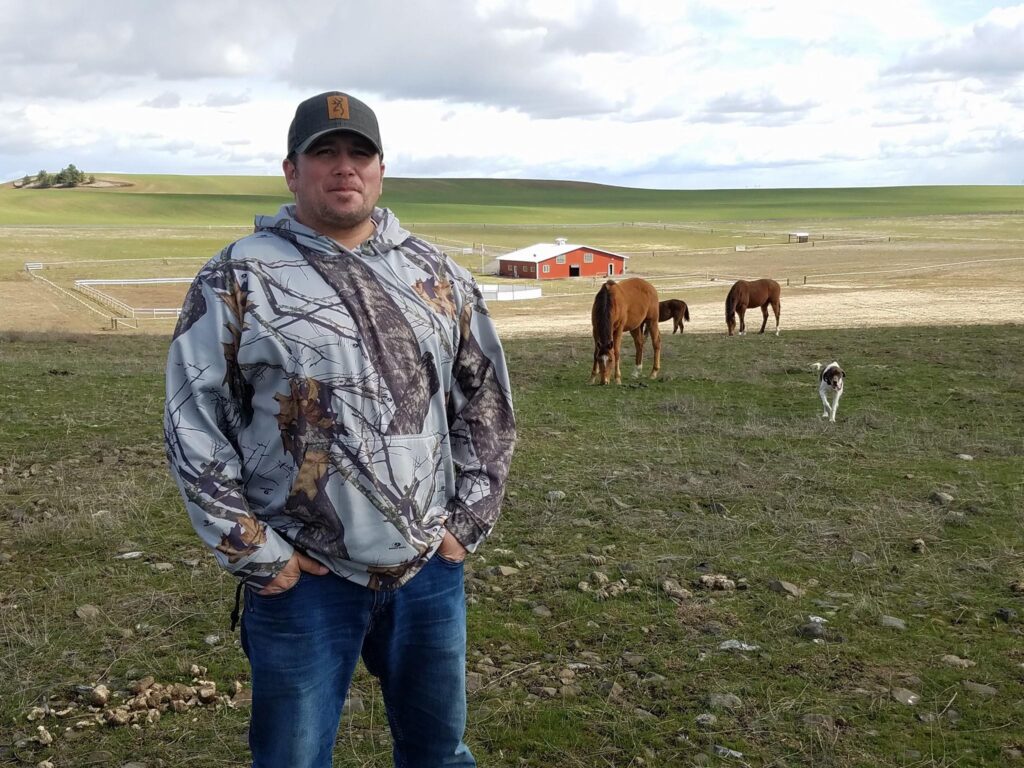
Retired Racehorses, Combat Veterans Find Healing at Down the Stretch Ranch By: Alexandra Kokka Fifty miles west of Spokane, Wash., away from the hustle and bustle of big city living, everything gets quiet at Down the Stretch Ranch—a solitude that eases the restless minds of both veterans and retired racehorses. Horse racing and civil service were certainly ingrained in the McCanna family genome. A third generation horseman and younger brother of Washington State Hall of Fame trainer Tim McCanna—Daniel “Boone” McCanna grew up on the backstretch working in his father’s shedrow alongside his Marine Corps veteran cousin, Mark Moran. Boone went on to spend nearly three decades as a jockey agent before deciding it was time for a change of pace. “It was actually my mom’s idea to start a Thoroughbred retirement facility,” Boone recalled. “My dad always turned his horses out half the year because it was just a seasonal meet in Spokane and then his old horses were always retired at our family farm.” The respect the McCannas showed their horses on and off the track was the catalyst for Down the Stretch Ranch. Then it was Moran who insisted the organization’s mission include rehabilitation for veterans. “Mark was a Marine in Vietnam when he was 19,” Boone explained. “One day, while walking through the jungle, someone in their company stepped on a time-triggered explosive. Mark was the third guy from the back of the line and it blew his entire leg off.” A large percentage of veterans struggle with post-traumatic stress disorder, caused by experiencing or witnessing a terrifying event that can cause nightmares, flashbacks, and severe anxiety. Upon returning from Vietnam, Moran experienced firsthand the cathartic effect working with Thoroughbreds provided his mental health. In 2014 Boone co-founded Down the Stretch Ranch to serve as a place of solace for retired racehorses and veterans alike. Since its inception, the ranch has been home to 25-34 ex-racehorses every year. Determined to provide the same opportunity to combat veterans in his community, Moran dedicated himself to forming a veteran therapy program at the farm. The Purple Heart and Bronze Star Marine Corps veteran’s efforts have allowed hundreds of guests to gain access to the life-changing therapy. “I was never in the military, so it was really nice when we came home to get it started that Mark would be able to talk to the veterans and relate to them better than I could,” Boone said. “He died five years ago, but we’ve kept the veteran program going because it’s a good thing and it honors Mark.” Over the years, two highly decorated warriors and U.S. Army leaders, Lt. Col. Gregory Allen and Lt. Gen. Michael Ferriter, have been invaluable resources for Boone, directing countless combat veterans to seek refuge at the ranch. According to Lt. Col. Allen—who served in the Army Rangers, Green Berets, and commanded an infantry battalion in Iraq before culminating his 27-year military career as the chief of staff for the Washington Army National Guard—every soldier is instilled with the “Warrior Ethos.” Consequently, those who display the greatest perseverance of valor and duty to their country experience the most unspeakable hardships while on tour. As a result, many combat warriors fail to heal their traumas through the conventional modes of rehabilitation provided by the Veterans Health Administration. “Every soldier has his own story,” Allen said. “A lot of the infantry guys, they’re the ones really out on the front lines constantly, going on missions night after night. It gets really stressful and afterwards it’s hard to come back and have a normal life. Some of these guys just need a new direction. When I heard what Boone was doing, I knew we needed to get these guys out there.” Boone allows the horses and veterans to forge their own relationships through intense, yet unspoken moments of mutual understanding. “Thoroughbred racehorses are highly trained, specialized, freaking great athletes, just like these guys that are warriors—there’s an instant connection,” Boone said. “I’m no therapist or anything, but letting these guys just kind of do stuff on their own time with the horses brings them out of their shell. To some guys I’ll say, ‘If you want to sleep in, sleep in; if you want to get up, you’ll hear me out here in the morning.’ Almost 10 out of 10 of them are up as soon as they hear me around the barn. “The ranch is a place that they can call theirs,” Boone said. “Most of the guys that come; they plan to come for a day and they end up staying for a week. Then, they keep coming back because there’s something different every day.” U.S. Army combat veteran Jerald Reichel served as a machine gunner for two tours in Iraq. In 2016, five years after experiencing an unspeakable amount of death and destruction, he continued to struggle with life as a civilian. Reichel was losing the battle to cope with his mental health and lost sight of a reason to live. “I’m 100% disabled with PTSD from combat,” Reichel said. “Six years ago I was living in a homeless veterans program. It was a really bad time in my life, I was going through a divorce, feeling depressed, and suicidal. I really didn’t see any hope for the future.” To this day, Lt. Col. Allen maintains close connections to countless warriors—including Reichel—who were under his command. In his retirement he has dedicated himself to connecting veterans in Washington to the resources that serve them best. “I was Jerald’s battalion commander in Iraq for about four years,” Lt. Col. Allen said. “He was a good infantry man and wasn’t the only vet I knew that had come back from that last deployment at the end of 2009 and had a hard time adjusting. That’s why I stayed in touch.” Despite the 150-mile distance, when Lt. Col. Allen suggested Boone bring a struggling Reichel out to the ranch, he made the arrangements to pick him
Different Countries, Same Care
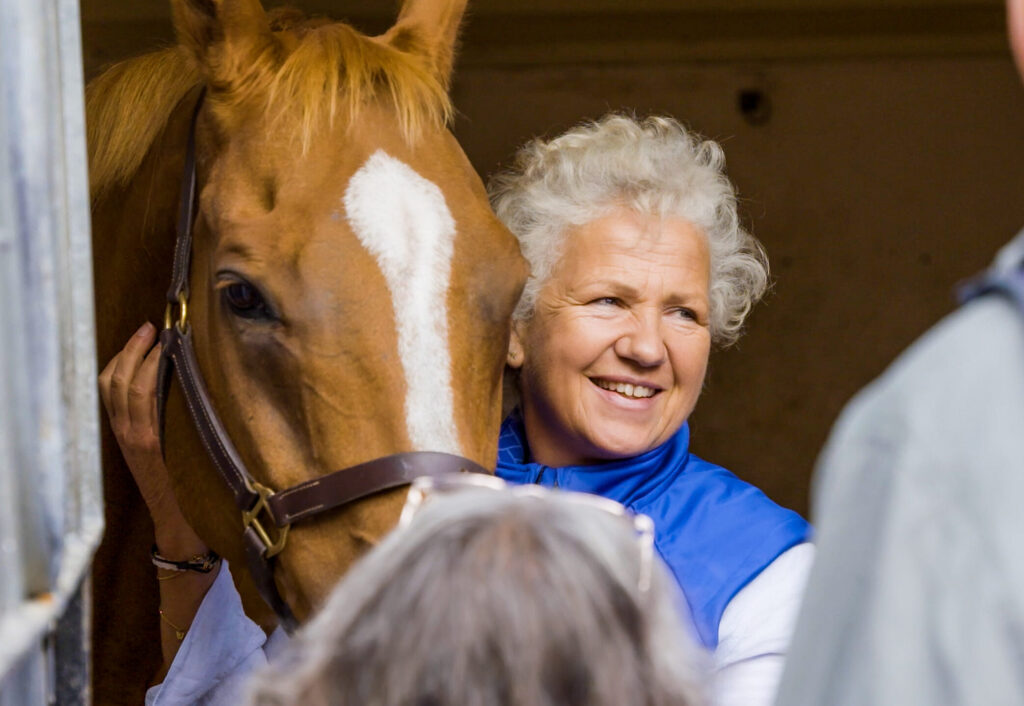
Godolphin’s Lifetime Care Ensures Safety Net for Its Horses, Worldwide By: Alexandra Kokka Godolphin has cemented its place among Thoroughbred racing’s most renowned owners and breeders worldwide, demonstrating the possibility to achieve success at the highest level of the sport spanning four continents. The same world-class effort Sheikh Mohammed’s Godolphin has displayed in breeding and racing horses also applies to aftercare. The Thoroughbred Aftercare Alliance recently caught up with Godolphin’s strategic adviser for charities, Diana Cooper, to discuss the evolution of aftercare in the organization. “Since the very beginning of Godolphin, we have had an aftercare program that has evolved over the years,” Cooper recalled. “About seven years ago we became more proactive about formalizing the programs we had in each country under the Godolphin banner, and so the Godolphin Lifetime Care brand name came to fruition. Our objective is to create a greater awareness, passion, and care for these Thoroughbreds throughout their lives, to provide and encourage the best possible lifelong care.” Godolphin Lifetime Care representatives around the world were among those in attendance for these early meetings and annually hold court with aftercare and racing representatives. Every Thoroughbred who is a part of the flagship ownership entity has a safety net for the duration of its life, long after retiring from racing. “In each country where Godolphin operates, we have a lifetime care program that reflects the culture and fits in with the infrastructure of the industry in that country,” Cooper explained. “We are very proud to be able to promote the secondary careers of these horses around the world.” Because of differences in practices, policies, and demand for Thoroughbred aftercare among countries, GLC programs in Europe, Australia, United States, and Japan have individualized protocols. More than anything else, the depth of the GLC program depends on the level of preexisting aftercare infrastructure already in place in that racing jurisdiction. UNITED STATES In the U.S., Godolphin’s Lifetime Care program is overseen by Godolphin racing office and sales manager Emma Browne Lovatt, who has been under the Godolphin umbrella for 20 years. Although she wears many hats for the U.S. racing and breeding operation, Lovatt takes great pride in the success of the aftercare program. “The Lifetime Care program is a very important aspect of the business model: It’s part of the way we do business, and it has to be included in what we do,” Lovatt said. “Their racing career is the smallest part of their life, and we’ve got to try to ensure that the rest of their lives, whether it be the next 15 to 20 years, is somewhere they will be well taken care of.” Since 2014, Lovatt estimates she has helped rehome nearly 184 Godolphin horses. Horses are either rehomed directly following their letdown period or are transferred to an aftercare organization that provides retraining and adoption resources. “I have a wait-list of people interested in adopting Godolphin graduates—it’s ginormous,” Lovatt said. “I also use TAA-accredited New Vocations and the Secretariat Center.” Horses that transition through TAA-accredited organizations are protected under the TAA’s Code of Standards. Thanks to the preexisting infrastructure the TAA and its 81 accredited organizations provide, Godolphin horses that otherwise would be rehomed with no retraining have the opportunity to discover what discipline they are best suited for in building a foundation toward a second career. For example, Godolphin-trained gelding Regiment made two career starts and never broke his maiden. The decision was made to retire the son of Indian Charlie from racing, thus activating the next phase of his life—transitioning through the GLC program. Regiment spent six months in training at the Secretariat Center in Lexington, where it was quickly determined that, with the right adopter, “Reggie,” had the potential to be an upper-level eventer. Fast forward seven years to 2022, Regiment and adopter McKenzie Dey Cumbea have successfully completed numerous four-star events. EUROPE Across the pond sits Godolphin’s most in-depth Lifetime Care program, where retired racehorses receive rehabilitation as well as retraining for a second career. However, rehoming is not the only mission that the European Lifetime Care program serves. It also houses select retirees to help promote the path for retired racehorses. “In Europe our retraining program is based in the U.K.,” Cooper explained. “At our Newmarket retraining facility, we look after horses that have been particular friends to us. We retrain them, and they become our ambassadors.” Among the most beloved of the UK Lifetime Care program ambassadors is 2004 Ascot Gold Cup (G1) winner, Papineau. Just this fall, the now 22-year-old gelding launched the new school year at the Newmarket Academy, accompanied school children to pay their respects at the statue of Her Majesty The Queen, welcomed more than 790 visitors during the Sir Henry Cecil Open Weekend, and even brought joy to some patients at the Newmarket Hospital. “The horses that we’ve used for racehorse parades to be our flag-bearers include African Story and Prince Bishop, winners of the Dubai World Cup (G1), Ascot Gold Cup winner Papineau, and (trainer) Charlie Appleby’s Melbourne Cup (G1) winner, Cross Counter,” Cooper said. AUSTRALIA Similar to Godolphin’s efforts in America, the GLC program in Australia provides direct rehoming or retraining, depending on each horse’s needs. The southern hemisphere operation also maintains flag-bearers to represent Godolphin during race parades and open houses. “In Australia, the majority of horses that we rehome fit into programs that already exist,” Cooper explained. “These programs really suit the industry and adapt our horses as much as possible for their future careers. Hartnell was a champion racehorse and is now a champion in aftercare competitions.” JAPAN Yasuko Sawai has been with Godolphin for 16 years, first working in the Darley Japan foaling barn for 10 years before taking on the responsibility of managing the Japanese GLC program in 2015. “We do our Lifetime Care program two ways. One, we have a rehoming program for our racehorses and, two, we want to improve aftercare by educating racing people,” Sawa explained. “We have rehomed around
TAA at Ten
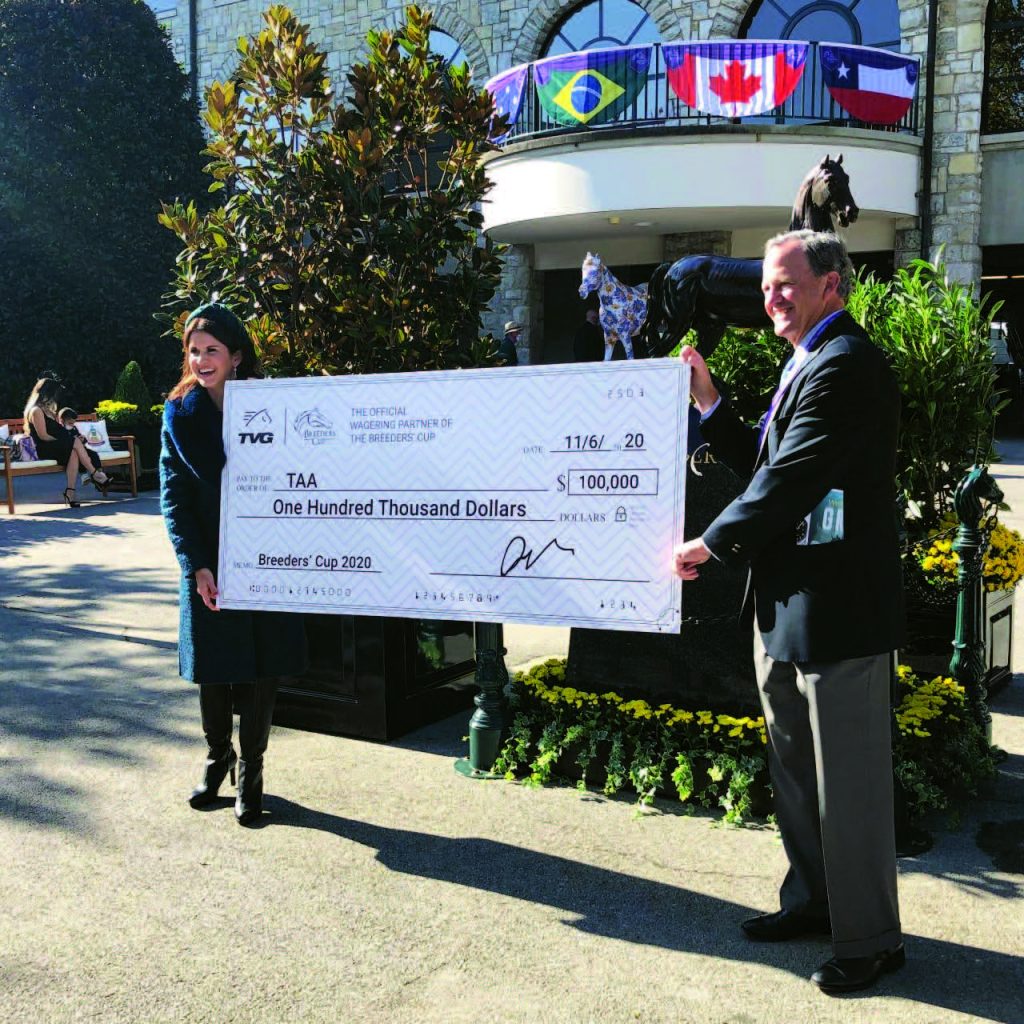
Thoroughbred Aftercare Alliance to Ring-in Anniversary at Breeders’ Cup By: Alexandra Kokka For a long time many in the racing industry gave little thought to the welfare of a Thoroughbred after it finished its racing career but that mind-set has changed in recent decades. The late 1990’s and early 2000’s saw a number of unfortunate incidents on and off the racetrack involving horse racing legends such as Exceller, Ferdinand, Barbaro, and Eight Belles. The losses of these horses and others not only affected the racing industry, but rallied equine welfare advocates and shaped the general public’s opinion as well. As a result, equine welfare organizations began sprouting across the United States, but these organizations went unregulated and underfunded. Spurred by the crisis before them, major racing industry pillars began conversations on the best ways to combat racing’s poor public perception and ensure racehorses have a safe and dignified life upon retirement from racing and breeding. In October 2011 a strategic planning session was held at Keeneland’s Keene Barn to formalize an actionable plan to protect equine athletes and ultimately horse racing. In attendance were leaders from Breeders’ Cup, Keeneland, and The Jockey Club, among others. Out of this meeting came the idea for a new association on the issue. By 2012 the Thoroughbred Aftercare Alliance was founded. Funded initially by seed money from Breeders’ Cup Ltd., The Jockey Club, and Keeneland, the TAA declared a mission to accredit, inspect, and award approved aftercare organizations grants to retrain, retire, and rehome Thoroughbreds through funding derived from all aspects of the racing industry. In the 10 years since its inception, the TAA has remained true to its objective. California Retirement Management Account (CARMA) founder, Madeline Auerbach, and Breeders’ Cup executive vice president and chief racing officer, Dora Delgado are among those instrumental in the TAA’s formation. They fought tirelessly for a decade to facilitate the TAA’s growth and stature within the industry, and are still active supporters of it today. As such, what two better people to sit down with to reflect on the past 10 years of unprecedented progress, ahead of the TAA ringing in its tin anniversary at the 2022 Breeders’ Cup World Championships hosted by Keeneland. AK: How much has the landscape changed in 10 years? MA: It’s hard when people weren’t around at that time to understand what happened. You have to put yourself in the frame of mind of going back 10-plus years. The industry always has problems, but we had very serious, very dangerous to our business problems with what happened with Eight Belles and things of that nature. The industry was in a crisis … Now we can point to the things that we do as an industry, and it’s vital that the industry has a spokesperson, a spokes-entity, where these media outlets can go when they want information. I think most people would say that The Jockey Club, Keeneland, and Breeders’ Cup are major leaders in the industry. We needed those three entities together. They are three parts of the stool that supports our industry— the racing industry—and they had to be on the same page. At the time, the Breeders’ Cup was under Craig Fravel’s leadership. They were 100% in, just as Keeneland and The Jockey Club were. AK: Without question, the Thoroughbred Aftercare Alliance would not have gotten its feet off the ground without the Breeders’ Cup, The Jockey Club, and Keeneland stepping up with initial donations of $100,000 each. What was the significance of Breeders’ Cup being a seed money donor for the TAA? DD: The idea was broached to have an accreditation process for some of the retirement homes that were already out there and for new ventures that wanted to get involved. We knew there was some groundswell movement, and I think all of this really had stemmed from the tragedy [of Ferdinand] over in Japan. It opened people’s eyes that we need to take care of these horses. So I think for us [at Breeders’ Cup], it was a really easy step—to say we want to do something, to say we want to be part of something bigger and have the industry come together and make sure we give horses a soft landing when they retire from the racetrack. MA: That seed money is the only reason the TAA exists. We wouldn’t be here without the $100,000 each from those three entities. It never would’ve taken off the ground because nobody would’ve had the money to start it. In essence, those three organizations put their money where their mouth was and they turned it over to those of us that were trying to put it together and trusted us to spend it cautiously, wisely, and correctly. Over the past decade the TAA has worked steadily to increase the amount of accredited aftercare organizations under its umbrella and the number of donors within the racing industry to supply the grant funding for retired Thoroughbreds being cared for by those organizations. However, the TAA did not immediately explode on the scene in terms of horsemen’s understanding as to how it differed from every other aftercare nonprofit. The Breeders’ Cup recognized this struggle early on and knew it had to be one to show the rest of the industry who the TAA was and why the organization deserved support. AK: In what ways have Breeders’ Cup and TAA worked together in the past 10 years? DD: Initially when the TAA first got started, there was a stallion funding mechanism. Since we were already involved in billing stallions for the Breeders’ Cup, that was part of our early, initial efforts to help. We also tried to include ads in whatever publications we were doing. We’ve become much more focused on that in recent years. As we’ve had vehicles created to help push the Breeders’ Cup messaging, it’s a very easy thing to add on: ‘Please support the TAA.’ The work is so important. All of our outgoing nominations messaging has a
Full Circle
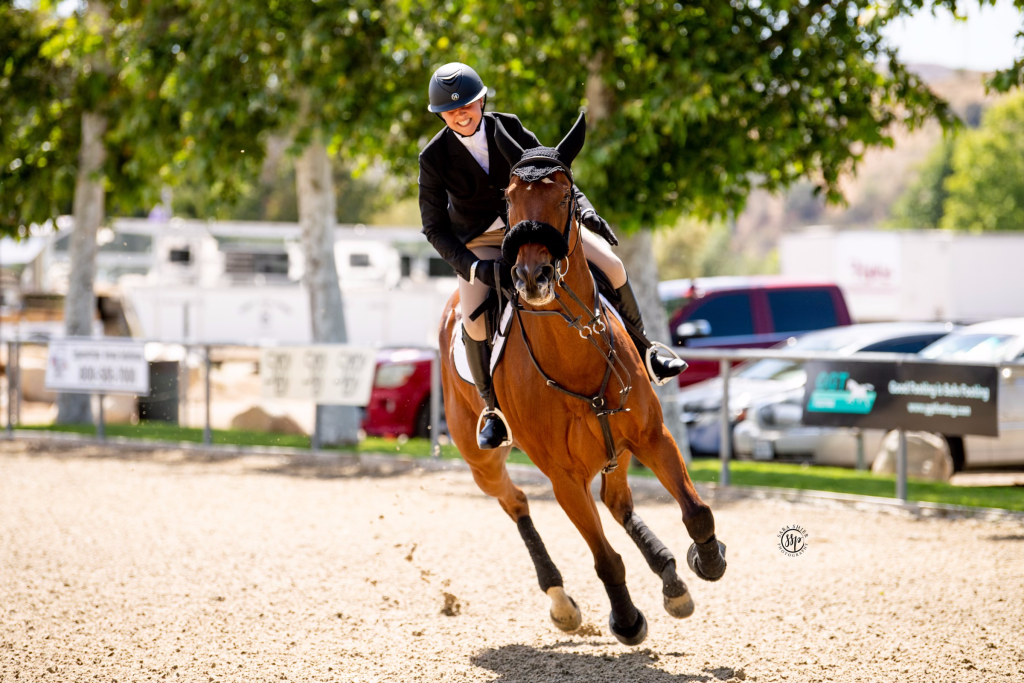
The life of a racehorse comes full circle, thanks to the many individuals who saw the potential in one retired Thoroughbred. Anyone in the horse industry can attest that no matter how much thoughtful planning and hard work are put into caring for a horse, things can change in an instant—for better or for worse. Luckily, sometimes unexpected changes are just an opportunity to gain a different perspective. Crosscheck Carlos could have been a great racehorse, but through a series of good and bad events, he was given the opportunity to experience life from a new point of view. Bred by Allen Guillotte Jr., Crosscheck Carlos was foaled in 2015 out of stakes-placed Weepnomoremylady (by Summer Squall). A half brother to Louisiana Cup Distaff Stakeswinner Flower Lady (by Flower Alley), Crosscheck Carlos was acquired by Erik Johnson and Dennis O’Neill at the Ocala Breeders’ Sales March 2-year-olds in training auction for $37,000. The son of Custom for Carlos made most of his eight career starts for trainer Doug O’Neill, under the ownership of Johnson’s ERJ Racing, Slam Dunk Racing, and Neil Haymes. True to his Louisiana-bred roots, in his second start Crosscheck Carlos won the $100,000 D. S. Shine Young Futurity at Evangeline Downs. “Crosscheck was a very willing, athletic, and competitive horse; the type to separate himself from the pack,” Doug O’Neill recalled. “He was a real pleasure to work alongside.” Unfortunately, after finishing second best in his 3-year-old debut, the stakes winner suffered a career-ending sesamoid fracture. Despite the uncertainty a diagnosis of that severity can bring, Crosscheck Carlos had all the right people on his side. “You take on the responsibility and the honor to work alongside these amazing horses and you take care of them every day they’re with you,” O’Neill said. “When they no longer race due to ability or injury, it’s our responsibility to help them move forward in the next chapter of their life.” Unbeknownst to “Carlos,” he’d already caught the eye of Brooke Abbard during his time on the track, and she was ready to give Carlos the soft landing he needed to get back on his feet. “I took Carlos from Doug O’Neill right after his injury,” Abbard said. “I specifically asked for him because I knew him from the barns. I manage a racing stable at the track, so I’m around all the racehorses all the time and Doug O’Neill is one of our trainers.” Abbard transported the 3-year-old to her barn off of the track where they began the long road to recovery. In time, Abbard hoped Carlos would make a dependable trail partner. “You never know how the sesamoid is going to heal; if it’s going to heal perfectly or if they’re not going to be able to have a second career,” Abbard said. “He stayed in a stall in my barn. I hand-walked him three times a day, wrapped it and unwrapped it every day. A lot of work went into healing him successfully.” After nearly two years with Abbard, Carlos’ playful, intuitive nature shone bright. It was apparent the gelding was ready for his next adventure. “Carlos was a special horse,” she said. “He would help me rebed his stall every day. I would just throw a bag of shavings in there and he would undo the bag and fluff his own stall for himself.” Abbard did more than just heal his injury, she ensured Carlos was prepared to find his forever family. Enter Manon Prat, wife of successful jockey Flavien Prat. Before moving to the United States, Manon Prat grew up in France, competing in show jumping and eventing, but her passion for the track eventually took over and she made the decision to pursue exercise riding full-time. She worked on the backstretch as an exercise rider both in France and the U.S. for nearly 10 years. After the birth of their first child in 2018, Prat made the tough choice to quit galloping and focus more on her family. Prat felt at a loss without riding on a daily basis, so the new mom decided to trade in morning breezes on the track for something a little slower—an off-track Thoroughbred. “Horses are my life; that’s something I need, I’m not whole if I don’t have that,” Prat explained. “My husband told me, ‘If you want a horse, I know you like jumping, so maybe you should start jumping again.’ Then, we started looking to get a horse.” Prat began getting back into the swing of English riding with fellow racetracker Maria Falgione, who was retraining two off-track Thoroughbreds and would have Prat out to ride with her. Around the end of 2018, two worlds collided when Abbard sent a certain recently rehabbed stakes winner to Falgione for her to consider buying. With two horses already on her plate, Falgione called Prat, suspecting Crosscheck Carlos might be just what she is looking for. “Maria had two horses at the time that I would ride,” Prat recalled. “They were nice horses, but for whatever reason, I had no attachment to them and they were for sale as well. But you know that kind of thing where you just get on a horse and get that feeling? When I got on Carlos, I really, really liked him. He’s everything I was looking for in a horse.” Crosscheck Carlos was home. One can’t help but admire the synchronicity. Prat and Carlos each went through huge changes in their livelihoods over the past two years, involving changes to their physical and mental selves, but each leaned on the connections they had made along the way, ultimately leading to one kismet moment. As if that weren’t serendipitous enough, when Flavien asked his wife the name of the bay Thoroughbred who had captured her heart, another connection was realized. “Flavien was the first jockey Carlos had on his back and the jockey he won his first race with,” Manon Prat explained. “That was pretty cool because we had no idea
Ensuring a Legacy
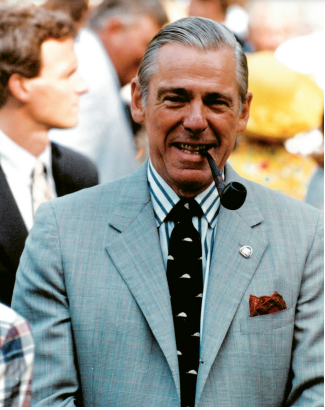
Few in racing can say they have accomplished more for retired racehorses than the late John Hettinger. After nearly two decades working abroad–first in corporate sales and marketing, then in real estate development where he ultimately made his fortune–Hettinger and his wife, Betty, returned in 1973 to take over Akindale Farm for John’s father. Located just north of New York City, Hettinger transformed the 55-acre farm into an 800-acre Thoroughbred breeding and racing operation complete with a training track, shedrows, turnout paddocks, and more. The Yale University graduate campaigned numerous homebred multiple graded stakes winners; however, more notable than his influence as a breeder were his contributions to the sport as a whole. “John was essentially a white knight in 1991 when he and his family became the largest shareholders in Fasig-Tipton as it underwent restructuring,” said Fasig-Tipton president and CEO Boyd Browning. “John, as a human being, a shareholder, and a board member had more integrity and understanding of what’s best for the industry than most. He was an exceptional person of unbelievable character, of unbelievable guidance, and always wanted to make sure things were done the right way. He was a fantastic human being and a major influence on Fasig-Tipton and me personally.” Two years before Hettinger’s death in 2008, he transitioned 200 acres of Akindale Farm to be a sanctuary and an adoption facility for retired racehorses and formalized a succession plan to ensure its continued operation long after his life. “He didn’t just talk the talk; he walked the walk,” Browning said. “During his planning for when he passed away, it was important for John to make sure that Akindale was utilized for retired horses. John also provided financial support for the aftercare program after he had passed. He was a true believer who took action to support what he believed and what he said.” Thanks to such planning, Hettinger’s intuitive vision and unwavering devotion to off-track Thoroughbreds live on as hallmarks of Akindale Thoroughbred Rescue. Hettinger was awarded a Special Eclipse Award in 2000 and eventually was inducted into the Hall of Fame in 2019 for his numerous initiatives to support aftercare organizations and the off-track Thoroughbreds they serve. In 2000 he spearheaded the National Thoroughbred Racing Association’s inception of the Racehorse Adoption Referral Program, and in 2001 he founded Blue Horse Charities. “I think John was the godfather; the person who really took the torch and raised the bar in terms of the industry’s understanding of aftercare,” Browning said. “He was a very vocal opponent of slaughter in the United States. He cared deeply about horses and was a founding father of the aftercare movement.” Over the past decade the racing industry has faced many challenges, especially those relating to the welfare and aftercare of its equine athletes. The development of the Thoroughbred Aftercare Alliance in 2012 is one of the industry’s leading achievements and is a testament to the shared desire to ensure a safety net. For industry participants interested in moving these efforts forward, a detailed succession plan is a vital component. It’s a requirement of TAA-accredited charities. “The main reason we ask for proof of a succession plan is, we want to make sure that the horses have someone who can take care of them if the person who oversees the organization is gone–whether through sickness, death, or whatever the circumstance–if it means they have to be off for a certain period of time,” said TAA accreditation and grants manager Janice Towles. “At the end of the day, you definitely want to make sure that someone else knows what’s going on besides the main person.” Towles said such planning is especially important with smaller operations. “What we’ve found is that a lot of these operations are a one-person show and everything that they knew, they had in their head,” Towles said. “Unfortunately, if they weren’t there or an emergency broke out, they took that information with them. The biggest thing is that the organization does not become awash because nobody knows the operational side of things if the head or the founder is not there.” In general, there are a few key components for consideration when composing a comprehensive succession plan for an aftercare charity: defined roles for all staff, board members, and volunteers; short-term vs. long-term absences; planned vs. unplanned absences; and loss of a facility. Chain of command succession, cross-training staff, and maintaining an up-to-date, detailed operational guidebook are considered TAA best practices. Located in Greenwich, N.Y., ACTT Naturally was founded in 2013 by lifelong animal advocate and exercise rider Valerie Buck. Despite having a comprehensive background working with on- and off-track Thoroughbreds, Buck hadn’t yet considered the necessity of a succession plan prior to applying for TAA accreditation. “When I was filling out the accreditation application for the Thoroughbred Aftercare Alliance, they wanted a plan of succession, and I had to Google what a plan of succession was,” Buck recalled. “I applied for accreditation in 2019, so that’s when I put our first succession plan together.” Having realized the toll her absence could have on the horses in her care, Buck and the ACTT Naturally team worked quickly to develop a plan. Thankfully, the organization already had the necessary reliable partners, and now everyone knows what the plan of succession is, should it ever be needed. “It’s not like you can just close the shades for a while and walk away– [ACTT Naturally] is a constant living, breathing machine and the animals need to be cared for daily,” Buck said. “If something happens to me, there needs to be a plan to keep this organization going to continue rescuing horses. We sat down with the board and some of our core volunteers and put together a plan to make sure that if something ever happened that these horses are safe.” In this age, many horses live upward of 25 years. The residents of TAA-accredited Our Mims Retirement Haven had more than modern medicine to keep them bright-eyed
Ensuring Horses Stay Retired from Racing
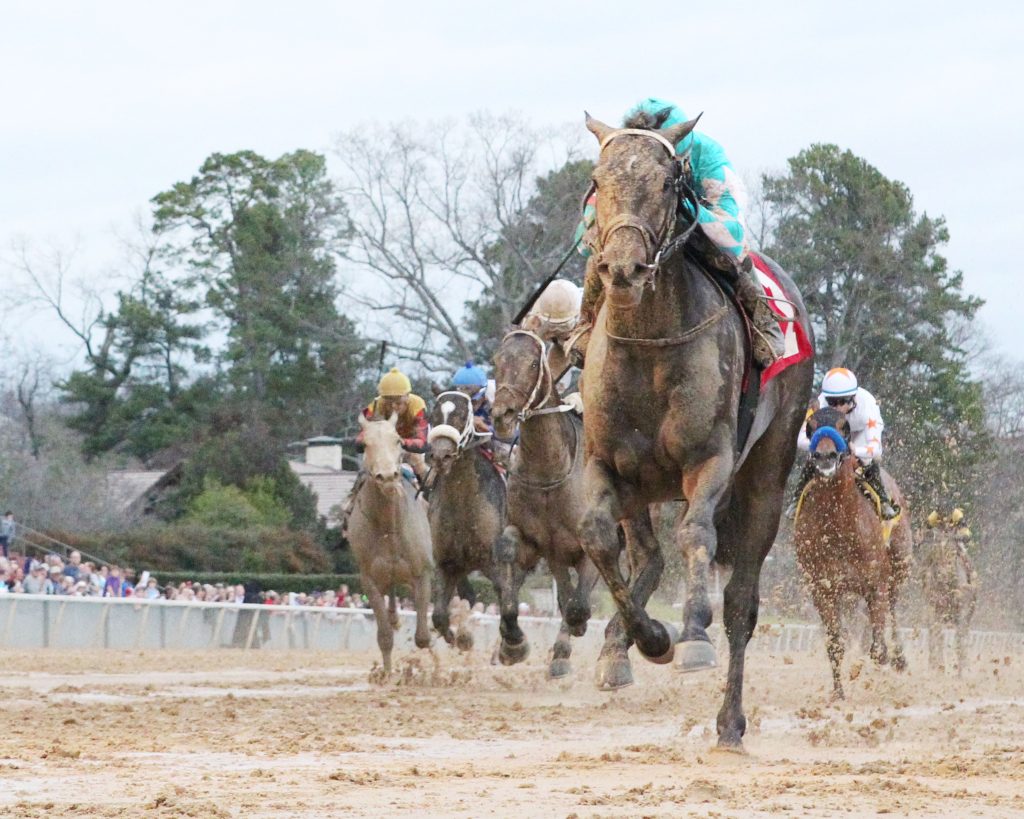
If you own a Thoroughbred in training, you most likely have heard of the many aftercare options available to you and your racing community. With 82 Thoroughbred Aftercare Alliance (TAA)-accredited organizations across North America and many supporting triage programs at major racetracks, the transfer of a retiring Thoroughbred can be seamless. One concern in this process is ensuring a retired horse will not be entered in a race under new connections. Often a retired horse will be transferred from the track to a trainer or an organization, but the foal certificate is left active. This misstep is a liability for the racing connections, but more importantly, it can be a threat to the horse’s safety. There are protocols in place to prevent this from happening. All TAA-accredited organizations have an adoption contract, which states the horse is being sold as “Not for racing.” However, the process that officially ensures the horse’s Jockey Club certificate will be made inactive for racing must be filed through The Jockey Club’s Registry Office. The Jockey Club registrar Rick Bailey explained the “Sold as Retired From Racing” process, which notifies North American racetracks of the retired status for Thoroughbreds. “If an owner wishes to mark their certificates as ‘Retired From Racing,’ there’s a process to do that for Thoroughbreds that are registered with The Jockey Club,” Bailey said. “It involves returning the completed form, which includes the notarized signature of both parties, photographs so that we can verify the identity of the horse, and The Jockey Club Certificate of Foal Registration to our office so that it can be recorded and stamped accordingly.” All of the necessary information and the “Sold as Retired From Racing” form are readily available online at www.registry.jockeyclub.com/registry. “Some tracks are more aware of the retired process than others—certainly the aftercare organizations are much more aware and a good number of the ‘Retired From Racing’ horses that we receive are from aftercare facilities,” Bailey said. A seasoned veteran of the “Sold as Retired From Racing” process, TAA-accredited Second Stride executive director Kim Smith shares her perspective as an aftercare facility taking in recently retired Thoroughbreds who still need their TJC papers to be stamped as inactive. “Second Stride transitioned 143 Thoroughbred sport horses to new homes last year for many types of post-racing uses and jobs,” Smith said. “We received foal certificates from the donating connections either digitally or in hard copy for approximately 40% of the horses.” TAA-accredited organizations such as Second Stride sometimes face a challenge in tracking down the Certificate of Foal Registration. “Often the papers are at a racetrack already closed for the meet. They’re left behind or transferred to the next track,” Smith said. “We often hear they were left in a van driver’s glove box. “So far this year we have had four out of 20 horses arrive with foal papers and a notarized form ready for executing to The Jockey Club ‘Sold as Retired From Racing’ database,” Smith said. “This year we started sending The Jockey Club ‘Sold as Retired From Racing’ form link to all our donors; we ask it be executed upon entry.” With the introduction of digital certificates, beginning with the 2018 foal crop, thankfully this issue is on the decline as Thoroughbreds with paper certificates age out of racing. Aside from the ‘Sold as Retired From Racing’ form, TAA-accredited organizations take additional precautions to provide a safety net for horses adopted from their organization. “We provide strict ‘No Race’ language in our adoption contracts,” Smith said. “Second Stride places our horses in the Equibase Virtual Stable Mail to be notified if a horse has published works or races. We then can proactively try and find out what is going on for any alerts. Usually it is a name similar to that of another horse currently working. This past Thanksgiving morning we had 2018 Kentucky Derby (Presented by Woodford Reserve [G1]) runner My Boy Jack show up with a published work. He was transitioned through our program and his adopter actually allows us to use him as an ambassador horse on tours, so we knew right where he was. We were able to reassure the prior connections that he was well and grazing on the farm.” Many TAA-accredited organizations also are careful to safeguard their adopted horses from going to slaughter by having clear language in their adoption contracts. Furthermore, the adopter agrees to include the same “No race or slaughter” language in any future sale contracts. “The adopted horse is placed with a lifetime ‘Not for race or slaughter use’ clause,” Smith said. “The adopter agrees that neither they, nor any future person or owner, shall race or slaughter the adopted horse, sell the adopted horse for race or slaughter use, or cause the horse to become available for purchase at an auction that could place the horse at risk of slaughter or race use.” While it is trickier to reclaim an OTTB at-risk of slaughter, Kim Smith’s team has a solid plan in place if an adopted horse shows up on the track. “The ‘bat’ phone starts ringing,” she said. “We would immediately notify the stewards of the related tracks, the track ownership, the track vets, and The Jockey Club. We can readily provide our paperwork and vet work to establish the situation and request the horse be put on the steward’s/track’s ‘No race’ list. We can also request that our attorney submit a ‘cease and desist’ letter to the person(s) in question, as well as to the other related parties. Our contract language also has provisions for return of the horse to Second Stride, and legal work can be started for that as well.” While TAA-accredited organizations do their best to provide a safety net for our industry’s athletes with or without the “Sold as Retired From Racing” form, the nonprofits end up spending considerable time, money, and resources that could otherwise go toward caring for more horses. “We find horsemen and owners are making a mental
Big Anniversary
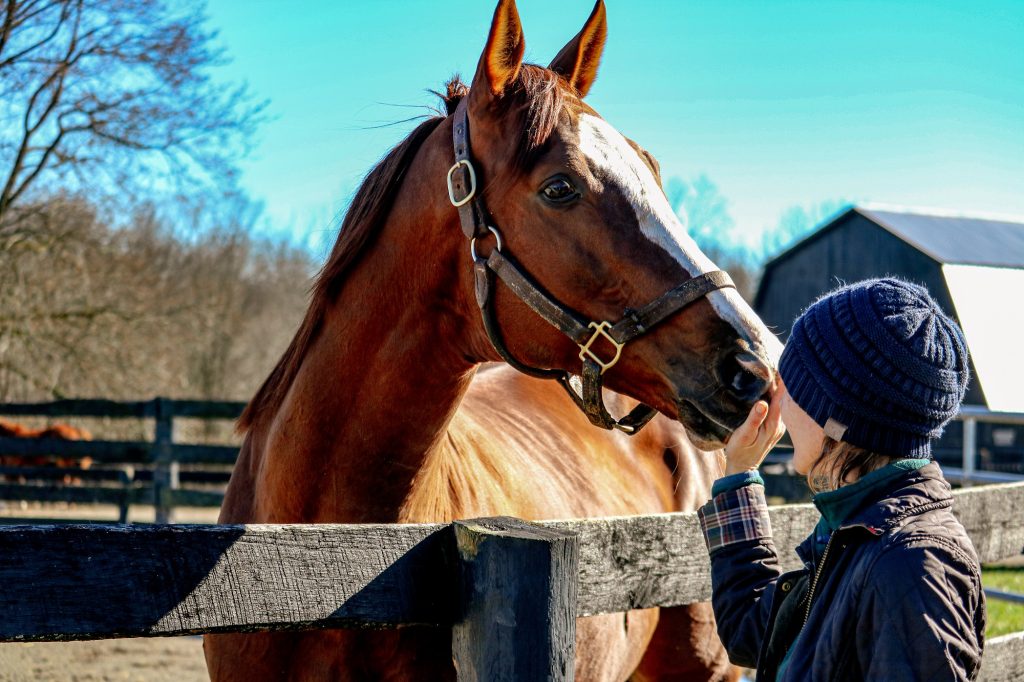
This year the Thoroughbred Aftercare Alliance celebrates 10 years of service since being established by the industry—an anniversary that offers racing an opportunity to make actionable goals for continued support of Thoroughbreds. Here is a look at where TAA has been in those years and where it might be going, with help from racing and aftercare industry veterans: Jeff Bloom, TAA president and managing director of Bloom Racing; Richard Schosberg, director and aftercare chair of the New York Thoroughbred Horsemen’s Association, president of TAKE THE LEAD, and TAA board member; Kristin Werner, senior counsel for The Jockey Club and administrator of the Thoroughbred Incentive Program; Jen Roytz, former executive director of the Retired Racehorse Project; Anna Ford, Thoroughbred program director for TAA-accredited New Vocations Racehorse Adoption Program; Lisa Molloy, program director of TAA-accredited ReRun; Laurie Lane, cofounder and president of TAA-accredited Second Call Thoroughbred Adoption & Placement; and Kim Smith, founder of TAA-accredited Second Stride. Q: Why is there a need for industry oversight of aftercare? Werner: The conversations about aftercare really started for me around 2009 or 2010. There was some retraining, retirement, and adoption going on and organizations like Thoroughbred Retirement Foundation, New Vocations, and Thoroughbred Charities of America were doing good work. But, the overall aftercare picture looked a bit piecemeal with gaps in services and areas of the country. And, it was not supported in any large part by the racing industry. As social media continued its rise in popularity, more and more cases of “rescue organizations” needing to be rescued began to appear. The general public became more aware of the fate of Thoroughbreds once their racing careers were complete. It was apparent that a multi-faceted solution was needed, which included accreditation of organizations providing aftercare, a funding source from industry constituents for those organizations to do their work, and incentive programs for Thoroughbreds in a second career. In the years that followed, this was accomplished through the formation of the Thoroughbred Incentive Program, Thoroughbred Aftercare Alliance, Retired Racehorse Project, and numerous other regional and track-based organizations focused on supporting organizations providing aftercare. Molloy: Prior to the formation of the Thoroughbred Aftercare Alliance, there was a time when there were so many rescues and programs operating without any guidance, provisions, or checks and balances. This created issues for those wanting to donate their horses and those wanting to donate money. Finding a way to responsibly retire a horse and ensure an empathetic and compassionate retirement with viable second career options really was a difficult path to navigate for an owner. The processes that are in place, especially using Thoroughbred Aftercare Alliance-accredited organizations working in partnership with racetrack programs like TAKE THE LEAD, provide transparency and prevent horses from falling through the cracks. Q: In the past decade what have you learned about the versatility of the Thoroughbred? Bloom: Over the last 10 years we have seen numerous examples and heartfelt stories of re-trained, re-homed, and re-purposed off-the-track racehorses. From assisting with therapeutic care for mentally and physically challenged children and adults, to full-blown sporting events such as polo, dressage, and eventing, to backyard trail riding, participating in television and movies and everything in-between, the Thoroughbred racehorse has proven to be incredibly kind, intelligent, versatile, and durable for use following their racing careers. Werner: I am fortunate to see on a daily basis how versatile the Thoroughbred is through my work with the Thoroughbred Incentive Program. We have Thoroughbreds participating in and excelling in hunter/jumpers, eventing, dressage, English and Western pleasure, barrel racing, ranch work, endurance, working equitation, therapeutic riding, equine-assisted therapy, mounted police, polo, polocrosse, competitive trail, recreational riding, and even skijoring. I am sure there are more that I am missing. Lane: It was the best kept secret. For those of us who worked with Thoroughbreds, we knew the versatility and the many incredible talents and tasks our Thoroughbreds could achieve just given the chance. Q: Do you think there has been a new interest in the Thoroughbred as a sport horse? Roytz: A thousand times yes. One of the most meaningful statistics that comes out of the data we collect from our Thoroughbred Makeover competitors each year is the ratio of first-time competitors versus repeat participants. Each year a significant portion of the competitors at the Thoroughbred Makeover are competing at the event, and often taking on the retraining of a Thoroughbred, for the first time. RRP’s mission is a bit different from most other aftercare organizations in that it focuses on expanding the market and increasing demand for Thoroughbreds in equestrian sports rather than doing hands-on re-training and re-homing. I strongly believe it takes both approaches to aftercare to be successful. The Jockey Club’s Thoroughbred Incentive Program and the TAKE2 program, both of which offer Thoroughbred-specific shows, horse show classes, and prizes throughout the country, as well as TIP’s recreational riding prizes and incentives, are other great examples of ways to incentivize equestrians to actively choose Thoroughbreds over other breeds for equestrian sports. Q: What do you think the factors in this have been that have helped a new interest in the use of the Thoroughbred? Roytz: Programs like the Retired Racehorse Project, The Jockey Club Thoroughbred Incentive Program, TAKE2 show series, and others that incentivize equestrians to compete on Thoroughbreds is a major driver in garnering new interest for Thoroughbreds in the equestrian world. I think adjusting our messaging as an industry will continue to help to appeal to equestrians. By positioning Thoroughbreds not as “retired racehorses” (which naturally insinuates a conclusion to their use/usefulness) but as “Thoroughbred sport horses” or “sport horse prospects” will make them more appealing to a non-racing equestrian audience as it focuses on these horses’ potential in new sports, the sports they are being marketed for, and that they will likely spend a more significant portion of their life doing. Q: What have been some of the most important developments of Thoroughbred Aftercare in the last 10 years? Ford: In the last 10 years
For Aftercare Organizations, the Success Stories Keep Coming
By: NYRA Press Office For Stacie Clark Rogers of the Thoroughbred Aftercare Alliance (TAA), there are several ways to measure progress in aftercare. One is concrete: following up the TAA’s banner 2021 by continuing to pursue the organization’s proven, long-range strategy in 2022 of raising funds for TAA-accredited aftercare facilities – all geared to re-homing retired racehorses. The other is more personal, best measured by the tales of the racehorses adopted and how they’re thriving in their new careers. For Clark Rogers, the industry’s “success stories” are what she and the others in the aftercare community relish most of all. “Fundraising will continue to be our primary focus because the assistance goes directly to the organizations now caring for the horses,” said Clark Rogers, the TAA’s operations consultant. “But we love hearing the follow-up stories about the horses adopted and how they’re doing. In New York, that means building on a number of successes in what was a great 2021.” The TAA awarded a record $3.7 million in grants in 2021 to 82 of its accredited aftercare organizations comprising approximately 180 facilities in North America, including 10 in New York State. Clark estimates that since the TAA’s inception it has affected approximately 13,700 horses, a number that should grow by more than 3,500 in 2022, which is about the average of the last several years. Among the organization’s highlights in 2021 was the inaugural TAA Day in August at Saratoga Race Course, which generated nationwide attention to the importance and benefits of thoroughbred aftercare. The two-day event on Whitney Weekend raised funds for various TAA-affiliated organizations, and provided significant exposure to aftercare at one of the country’s most prestigious and closely followed meets. “NYRA and the New York horsemen have been great supporters of TAA since our inception (in 2012), but TAA Day at Saratoga was amazing,” said Clark Rogers. “For us, it was a validation that aftercare is an integral part of our industry – and one that embraces the whole diverse racing community. That it happened at Saratoga, with such a large fan base and all the media coverage, was huge.” Backing the TAA in its pursuit of industry-wide funding is the steadfast year-round support of NYRA and its horsemen. Every owner competing at NYRA racetracks donates $10 per start to the TAA, which funds the aftercare organizations that provide homes for retired racehorses. New York’s horsemen also donate 1.5 percent of the purchase price of every horse claimed at a NYRA track to TAA and the New York Thoroughbred Horsemen’s Association’s Take the Lead program, which provides preliminary vet exams and treatment, as well as costs related to transportation, rehabilitation or retraining. The recently-concluded Big A fall meet saw 47 total claims made for a total of more than $1.34M, generating in excess of $20,000 for aftercare. Meanwhile, the hard work of accrediting more facilities and re-homing retired racehorses continues. Among the organizations achieving TAA accreditation in 2021 was Therapeutic Horses of Saratoga or THS, which specializes in equine assisted therapy and rescues and retrains retired racehorses for hands-on work with individuals in need. Clark Rogers is soon headed to Spokane, Wash., where she plans to meet with organizers of an equine therapy program for veterans called Down The Stretch. Small wonder that rehoming retired racehorses is an everyday task involving a never-ending number of details for New York-based trainer Rick Schosberg, who is on the TAA board and also runs the Take The Lead retirement program. Schosberg said the Take The Lead program is “rapidly approaching” its 900th horse placed thorough the program, a number it should hit in 2022. “At the moment, I have 12 horses who are transitioning off the track,” Schosberg said. “At any time of the week, we have anywhere from five to 12 horses on our list in different phases of transition. We are very busy and have horses leaving for retirement all the time.” Take The Lead’s goal with each horse is to create a profile and then network with potential aftercare facilities. To do so, the organization gathers information and medical records and ensures that a vet provide a thorough evaluation of each horse for soundness or any lingering injuries. Key is the need to research and find those horses the best fit and career, whether it’s show jumping, dressage, part of a rehabilitation program or as a companion, turned out on the family farm. Working to a retired racehorse’s advantage is what Schosberg called “an innate ability to learn new things.” “[From knowing] the starting gate, the big track, the little track and jogging the right way and the wrong way, they’re already processed for that,” Schosberg said. To make it work, Schosberg, Take The Lead’s executive director, Andy Belfiore, and aftercare coordinator, Kristin Mason, hold weekly conference calls with an eye to where the horses in transition stand. No detail is too small, from evaluating a thoroughbred’s quirks and habits to bringing in a vet for an exam to checking on van schedules to see if there are any slots on an upcoming trip to Saratoga or Florida in which a transitioning horse might catch a ride to its new home. “All in all, it’s a busy week and there are times when we’re inundated [with aftercare work],” said Schosberg. “The funny thing is that with modern technology, there are a lack of parameters, and I’ll get a call about a horse at 7 p.m. or 4 a.m. I tend to do a lot of my aftercare work before training – that’s between 3:30 a.m. to 5 a.m. when I’m headed to the barn. A lot of the answers to my questions come back in ‘now time,’ so I have them by the time training is finished. Things can move along pretty quickly.” Schosberg added that the commitment to aftercare from owners, NYTHA, NYRA and other parts of the industry in New York, combined with the best racing in the country, make New York “better than
Creative Fundraising
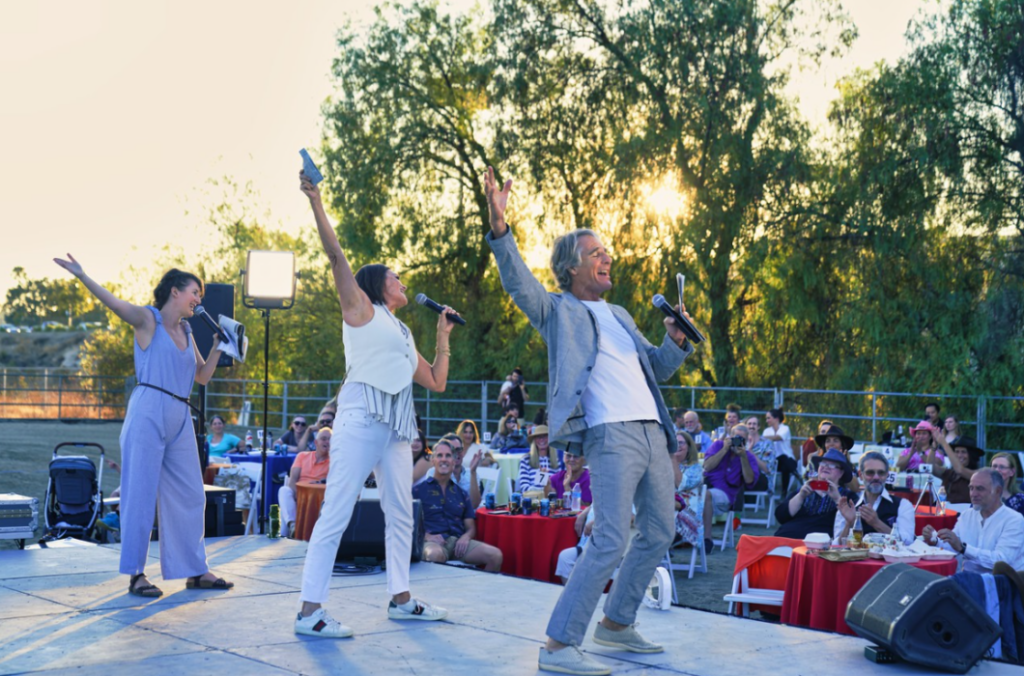
TAA-Accredited Organizations Found Way Forward in 2021 By: Alexandra Kokka As another year comes to a close, it’s only natural to feel compelled to reflect on the past 11 months, a year of innovation in Thoroughbred aftercare following the challenges of 2020 when business practices needed to change and events were canceled. Despite the turbulent highs and lows, the Thoroughbred Aftercare Alliance witnessed an array of opportunities for its accredited organizations and aftercare partners to advance initiatives. That’s worth celebrating because it’s easy to get bogged down in the weeds of aftercare and lose sight of the victories being achieved. At the same time, it’s important to understand that the work of effective, sustainable aftercare is not complete. In this year of transition, TAA-accredited organizations reported varied results in hosting fundraisers and events. Location played a crucial role in shaping the dynamics of events, with COVID-19 restrictions varying state-to-state and country-to country. After a bleak year of shutdowns, Southern California’s Win Place Home sought celebration in support of its Thoroughbreds that took the form of an outdoor cabaret, complete with food trucks, wine, great music, and, of course, a few horse selfies. “We found that people are not willing to donate a ton this year, and we’ve had a hard time raising money,” said Win Place Home founder CJ Wilson. “We had to cancel our annual silent auction and gala and our drag queen bingo event that we normally hold at the beginning of the year. But, we did start a cabaret for the first time outside among the horses. Everyone had a blast, and we hope to do it every year. We didn’t have a ton of people wanting to come out in person, but we made it socially distant and safe.” Canada, in particular, held fast to restrictions on in-person gatherings. That made fundraising events a challenge. Thanks to an idea Bev Strauss from MidAtlantic Horse Rescue shared during the monthly TAA Organization Committee meeting, Ontario-based LongRun Thoroughbred Retirement Society had great success hosting an engaging fundraiser. “The one new fundraiser we held was a virtual graduate horse race leading up to the Queen’s Plate,” said LongRun chairperson and founding member Vicki Pappas. “It went far better than expected and raised over $15,000. I believe people have been more than happy to help us out during the pandemic, and we have received a record number of adoption applications.” On top of an already difficult climate for nonprofit fundraising, tragedy struck TA A-accredited Equine Rescue of Aiken in April 2021 when its barn caught fire, resulting in the loss of more than $100,000 worth of supplies. Thankfully, no lives were lost. Equine Rescue of Aiken continues to dedicate itself to the community that supported the farm in its hour of need. Six months after the devastating fire, the rescue was used as a clinic site for six counties of South Carolina authorities to learn about identifying and rescuing at-risk equines. “The fire has brought on many challenges for us, but we always face challenges in this industry and we just don’t back down,” said Equine Rescue of Aiken president Jim Rhodes. Despite the unpredictable year that TA A-accredited organizations faced, many found creative solutions to host fundraisers and engage their communities. But not all 81 TAA-accredited organizations had the time and manpower to host new events. The Thoroughbred Aftercare Alliance’s ability to give grants ranging from $15,000 to upward of $170,000 is all the more meaningful during a time when aftercare organizations are struggling to maintain usual funding sources. These TAA contributions are by no means enough, but they are a very good start to sharing the responsibility and putting the Thoroughbreds first. As protocols were relaxed in some areas, the TAA was thrilled to represent its accredited organizations as the charity partner at major events such as the Pegasus World Cup Day, Preakness Stakes (G1), National Horseplayers Championship, Virginia Derby Day, and the Breeders’ Cup World Championships. “Partnering with the Thoroughbred Aftercare Alliance on major race days not only displays a united front that aftercare is not an afterthought but also allows other industry participants the opportunity to collaborate and give back to the Thoroughbreds,” said TAA funding and events manager Emily Scandore. This year, for the second straight year, TVG presented a $100,000 check to the TAA following the TVG Breeders’ Cup Juvenile presented by the Thoroughbred Aftercare Alliance (G1). TAA shared the funds with its California partner CARMA. Racing events returned with a renewed hunger for effective Thoroughbred aftercare funding solutions. Many racetracks, including Tampa Bay Downs, New York Racing Association tracks, Colonial Downs, and the Kentucky tracks help generate contributions to the TAA throughout their race meets by committing a small per-start fee from horsemen, matched by the tracks. 1/ST Racing’s Gulfstream Park and the Maryland Jockey Club each hosted Canter for the Cause events in support of the TAA, among the numerous other funding initiatives the track owner has in place to funnel money to the TAA throughout the year. “Maryland Jockey Club, The Stronach Group, and 1/ST all believe aftercare is very important to our industry,” said MJC vice president of racing development Georganne Hale. “The TAA is a very important organization in the racing industry. We must all support the Thoroughbred Aftercare Alliance, so they can make sure our horses are taken care of after their careers are over. Having events like Canter for the Cause brings funding and awareness to the TAA and the aftercare organizations that they support.” In 2021 industry aftercare partners showcased retired racehorses like never before, highlighting their increasing market value and popularity in a series of events and horse shows. For the second year in a row, CARMA held CARMAthon, a virtual fundraiser hosted by TVG. The virtual Thoroughbred aftercare fundraiser was so successful it received donations for a week following the event, resulting in more than $140,000. The Jockey Club Thoroughbred Incentive Program provided the structure for which horse shows across the country
Helping Find Horses The Right Homes
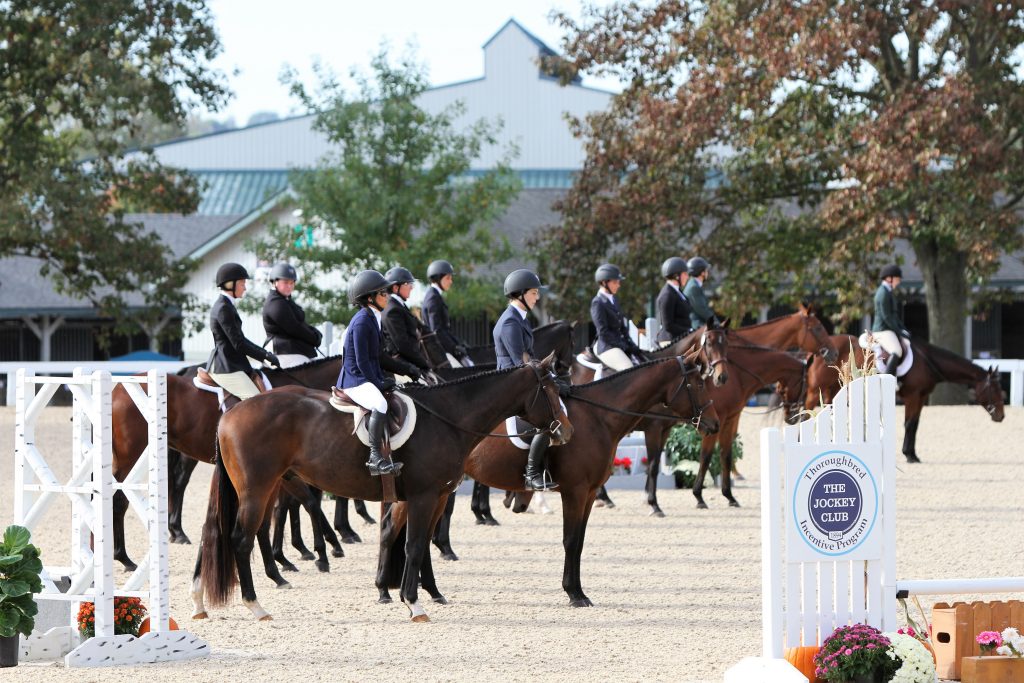
The first, and crucial, step toward a successful, responsible post-racing retirement for a horse is finding the right place for the horse to land off the track. And that’s where triage programs working together with TAA-accredited organizations come in.
Accredited Aftercare Expands Nationwide
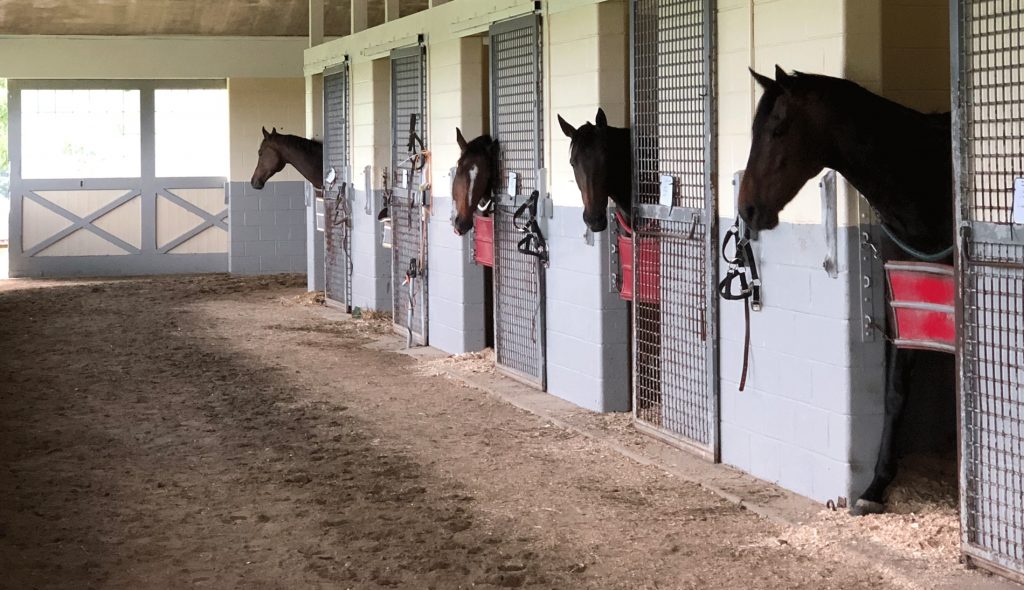
As the aftercare movement grows, Thoroughbred Aftercare Alliance-accredited organizations especially are gaining momentum. Three in particular have attributed their TAA accreditation status to helping this expansion.
Thoroughbreds for Therapy
“There is something about the outside of a horse that is good for the inside of a man” is ringing true more than ever in Thoroughbred aftercare.
With Solid Foundation, CARMA Placement Program Thrives
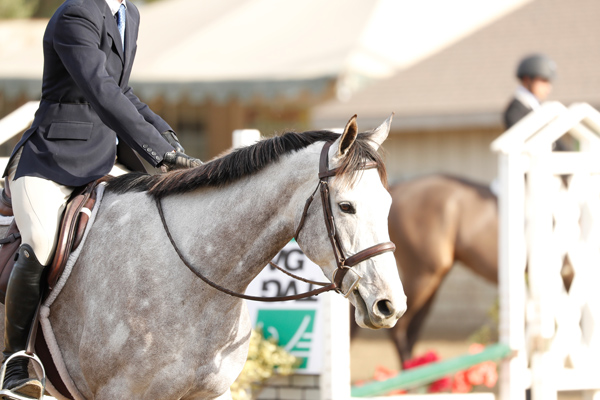
Successful Thoroughbred aftercare organizations run like well-oiled machines. Wanting to help horses is one thing, but having the industry knowledge and business acumen to effectively place racehorses safely into new homes while being efficient with funding is quite another.
Expansion Starts New Chapters for Two Aftercare Groups
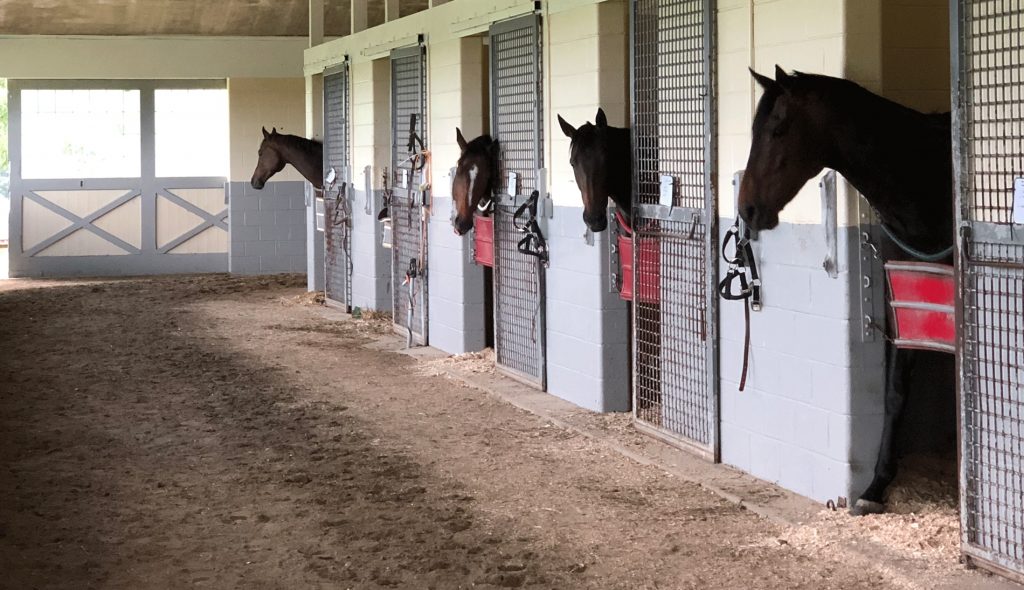
Over the past few years, the Thoroughbred aftercare and pro-off-track-Thoroughbred movement has exploded. Not only have the post-racing lives of racehorses become more top of mind for industry participants, but aftercare organizations have also been expanding their facilities, allowing more horses to be served.
Equine Advocates Teaches Children Horse Care
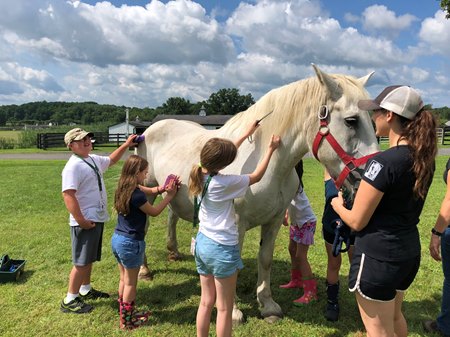
Is it possible to teach humans how to be compassionate caretakers of horses?
That’s what Thoroughbred Aftercare Alliance-accredited Equine Advocates near Chatham, N.Y., is working on. The 22-year-old nonprofit organization operates as a sanctuary and rescue, serving all breeds of equines, with an emphasis on humane education.
TAKE THE LEAD Eases Transitions for New York Runners
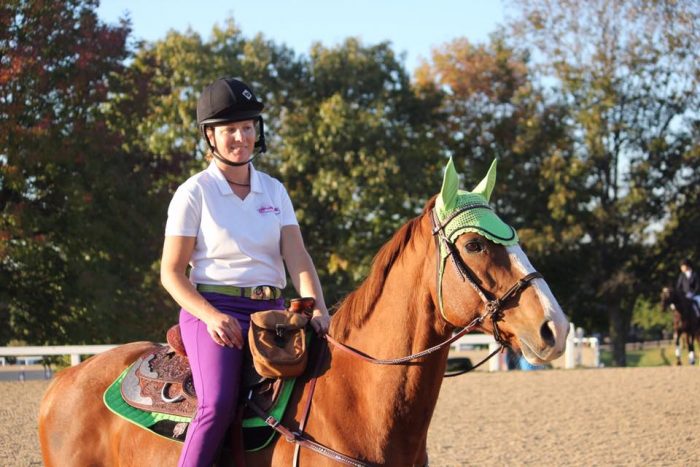
NYTHA’s TAKE THE LEAD works with TAA-accredited organizations to facilitate a safe transition off the track and into new homes and careers.
Maryland’s Beyond the Wire: An Industry-United Aftercare Solution
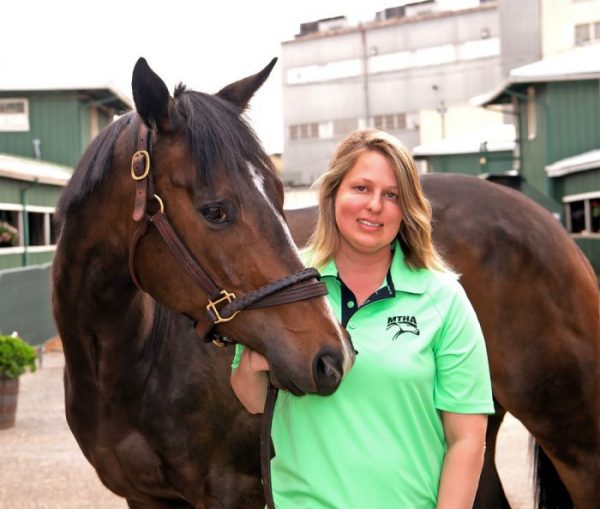
Maryland’s Beyond the Wire program facilitates a safe first exit from racing for horses and places them at Thoroughbred Aftercare Alliance-accredited organizations for retraining, rehabbing, and rehoming.
TAA President John Phillips: Investment in Aftercare is Better Viewed as Insurance
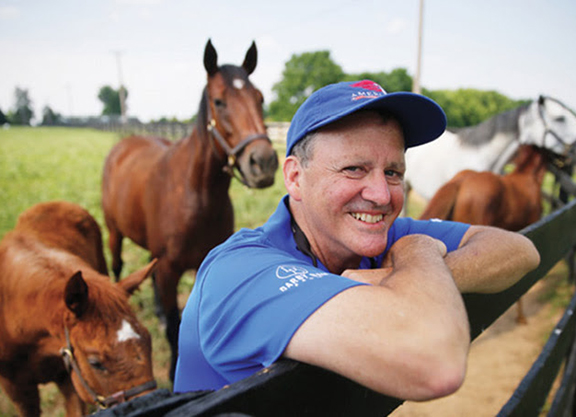
“The investment in aftercare is better viewed as an insurance premium, as in a business expense, or if you prefer, an obligation to the sport. … With the TAA, our sport now has the basic infrastructure.”
Gainesway’s Beck: Aftercare Vital for Racing’s Future
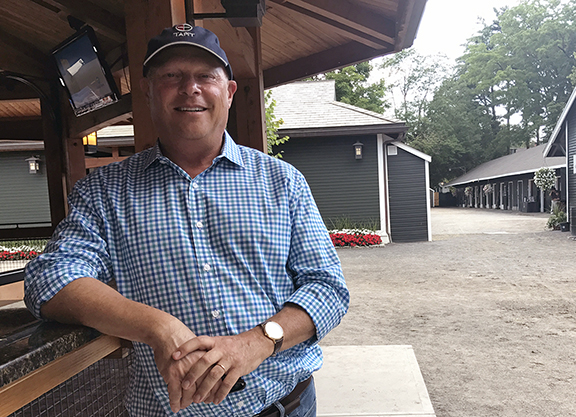
“Horses literally and figuratively are the vehicles for the racing and breeding industries. Their treatment is rightfully the focus of public perception and scrutiny, and, therefore, the sustainability of the Thoroughbred business depends on how we take care of our primary resource both during and after their careers,” writes Gainesway’s Antony Beck
Horse Tracking Initiative Could Evolve into Aftercare Tool
Santa Anita’s sign-out policy for foal paperwork is becoming more widely known, is being lauded within the aftercare community because it could eventually evolve into a best-practice way to track where racehorses go and exactly who is responsible for them upon any exit from a racetrack or licensed training center.
MMSC’s Thomas: Aftercare is Not a Charity Issue
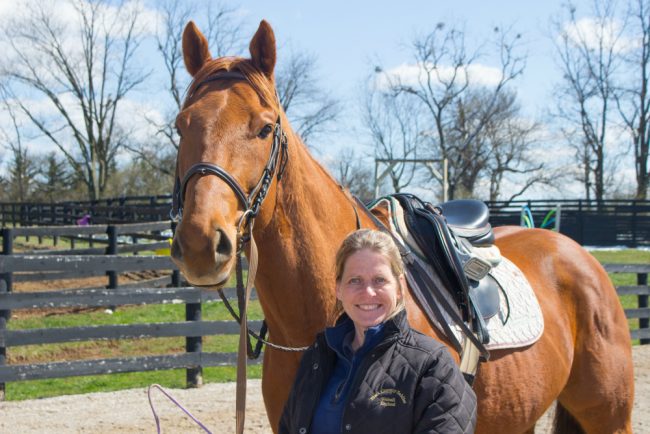
“I said then, and I say now, aftercare is not a charity issue. Aftercare is essential to the health and the longevity of this sport.” — Maker’s Mark Secretariat Center’s Susanna Thomas.
Alphabet Soup: What is in a name?
Alphabet Soup is one of our all-time favorite racehorses here at the TAA. In the 1996 Breeders’ Cup Classic at Woodbine, he was the horse who shocked the racing world with a track record performance, but it wasn’t just the time that was stunning. More than that, it was the horses he defeated. That year’s Preakness Stakes winner, Louis Quatorze, was second, while Cigar, the reigning Horse of Year and defending Classic champion, finished third in his final career start. Video courtesy of Breeders’ Cup Ltd. Alphabet Soup is retired and now resides at Old Friends, a TAA-accredited organization in Georgetown, Kentucky. He is living out his senior years sunbathing and eating carrots offered by fans after waiting for his cue from Michael Blowen, the founder of Old Friends. The veteran racehorse and former stallion officially turned 26 on Jan. 1, but his “real birthday” was March 31. Foaled in Pennsylvania, he not only became one of the most strikingly handsome Breeders’ Cup winners of all time—he is nearly snow white in color— but he also has a cute and catchy name. His dam’s name was Illiterate and her sire was Arts N Letters, so the name Alphabet Soup was a natural choice. “Soup” posing for carrots. Perhaps his “name giving” sort of had an Andy Warhol approach. In other words, why not make it about soup? It also dawned on me (very slowly I might add) that the name Alphabet Soup is actually possibly a quick witted moniker poking fun at the multitude of acronyms in the Thoroughbred industry. For example, just off the top of my head, there is the TJC, TOC, KTA, HBPA,RRP, BC, …and, well, the list goes on and on and on. So you might be wondering what does this have all to do with the TAA? Well, even after five years of being in existence, it’s not uncommon for us to be asked, “How is the TAA different from other Thoroughbred charities?” From the staff’s point of view, the first time we heard that, it seemed like an odd question because we are constantly consumed with accreditation applications, inspections, fundraising and awareness. Odd, that is, until we heard it a few more times. So all cuteness and smartness aside, let’s talk about what makes the TAA different from all of the other Thoroughbred charities (with a variety of acronyms) already existing in the industry. Like many other Thoroughbred charities, the TAA is a 501c3, and all of the organizations accredited by the TAA also have to have 501c3 or official charity status. That is where the similarities stop. The TAA was an initiative created by the Thoroughbred industry to support the retraining and rehoming of Thoroughbreds after racing. In order to be accredited by the TAA, each of the 64 currently accredited organizations had to go through a rigorous online application and site inspection process. And we do mean rigorous. The TAA is, in fact, the only accrediting body that fundraises for the approved aftercare organizations.As we have heard many times Michael Blowen of Old Friends say, “I’d rather be audited by the IRS, but it was worth it.” Every facility of every organization is inspected, and furthermore, every horse in every facility is entered into the TAA Horse Farm Management inventory system. TAA accreditation lasts for two years, and all facilities are subject to surprise inspections. The accredited organizations not only have a full review of their on-site operations but also have a full review of their financial statements and their horse health care procedures. What sets the TAA apart is the accreditation. We strive to help everyone be better, so best practices are shared amongst organizations. Groups that were not able to reach accreditation at first are mentored with the hopes that they will soon reach their goal of being accredited. That way everyone wins. In short, the TAA was created to support the network of aftercare, which is needed by both the racing and breeding sides of the industry, and consists of dozens of Thoroughbred aftercare organizations across North America. In the end, it all comes back to the horse, and the creation of the TAA insures that Thoroughbreds, like Alphabet Soup, are guaranteed one beautiful sunset after another. The TAA mission: The 501 (c) (3) non-profit Thoroughbred Aftercare Alliance accredits, inspects and awards grants to approved aftercare organizations to retire, retrain and rehome Thoroughbreds using industry-wide funding.